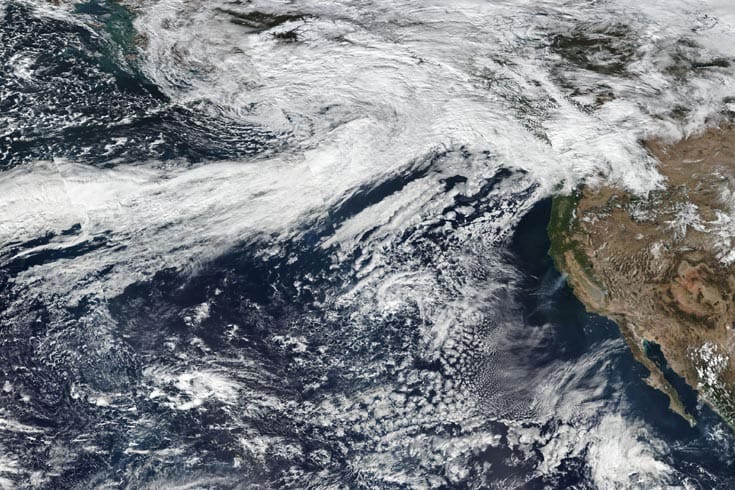
Story Spark: Atmospheric Rivers
Winter atmospheric river season has officially kicked off across western North America with a series of storms bringing strong winds, flash flooding, and heavy snow in British Columbia, the Pacific Northwest, and California. For these communities, the concept and potential threats of atmospheric rivers are well-known; it’s estimated nearly 90% of all flood damage in the western US comes from atmospheric rivers. However, as climate change fuels stronger and wider atmospheric rivers across the world, let’s bring the rest of us up to speed.
Known as “rivers in the sky,” these meteorological phenomena are essentially plumes of concentrated moisture high up in the atmosphere that transport nearly 90% of the water vapor from the warm, moist tropics to the drier mid-latitudes. These events, which can last several days to a week and stretch over a thousand miles long, are a critical source of water for many regions including California and Nevada — which rely on just a few storms brought about by atmospheric rivers for up half of their annual precipitation.
While they boost water supplies, strong atmospheric river events can also be damaging and costly — triggering catastrophic flooding, landslides, levee breaks, and debris flows. Research has found that these threats are amplified by atmospheric rivers that occur back-to-back, which are expected to become more common as our climate warms. Warmer air, which can hold more moisture, will also drive future increases in total rainfall during these storms — up to 40% more rain for some regions in California.
When covering this year’s storms, which will likely see an added boost due to this historic El Niño, make this climate connection clear for audiences. This season may serve as a glimpse into the changes scientists are expecting with a warmer atmosphere.
– David Dickson, CCNow
Reporting Tips
This week’s reporting tips are from me, CCNow’s David Dickson. As a meteorologist, I find these events to be a fascinating example of how our atmosphere behaves like a fluid — with dynamic shifts in moisture than you can easily see from space!
Not every event is the same — and they aren’t always destructive. Much like terrestrial rivers, ones high up in our atmosphere come in many different shapes, sizes, and ferocities. Some atmospheric rivers are broad and slow, while others are narrower and bring stronger, more damaging winds alongside heavy rain. Weaker events are often beneficial — boosting water supplies — while stronger, more prolonged events bring significant impacts. On this note, I recommend checking out the scale developed by scientists which assigns whether an event will be “mostly beneficial” to “mostly hazardous” depending on the amount of moisture and how long they’ll linger in a given location.
While famous on the West Coast of the US, atmospheric rivers occur around the world. At any given time there’s roughly three to five atmospheric rivers circulating somewhere on Earth, transporting tremendous amounts of water vapor from the tropics to higher latitudes. While common enough on North America’s western coast to warrant its own name (the “Pineapple Express”) atmospheric rivers often lead to heavy precipitation events elsewhere, including Western Europe, portions of Asia, and New Zealand. In fact, if you live between 30 degrees and 60 degrees north or south, you’ve likely experienced an atmospheric river bringing several days of windy, rainy weather.
They’re not a new phenomenon — though the term has gotten more public attention in recent years. Much like the terms “bomb cyclone” or “polar vortex,” atmospheric rivers are the latest meteorological term to take over the headlines, especially during recent strong storms over the past decade. While the term was first coined in 1994, atmospheric rivers have long been the source of heavy rain events dating back centuries. Similar to other headline worthy meteorological terms, there may be some confusion among your audience about what’s actually going on up in the atmosphere. (Spoiler: There’s no liquid river running through the sky.)
Stories We Like
- Grist examines how “hydroclimate whiplash” between flooding caused by intensifying atmospheric rivers and drought is leading to a surge in cases of a deadly fungal disease in California.
- The Xylom investigates the connection between extreme rainfall in the Himalayas caused by “cloudbursts” and atmospheric rivers in the US — and how climate change aggravates both events.
- Independent journalist Chase Cain gives an overview of the recent atmospheric river storms to hit the Pacific coastline. He breaks down how El Niño, a weakening polar vortex, and King Tides complicate its impacts.
- While widely known across the West Coast, atmospheric rivers are also responsible for devastating storms that can hit across the US and elsewhere, The New York Times reports.
Resources
- Use NOAA’s Atmospheric River Portal to access the latest information, satellite images, and forecasts of current and upcoming events.
- Find current analysis and forecasts for atmospheric rivers impacting the West Coast of the US on the Center for Western Weather and Water Extremes’ website.
- Explore the scale used to rank the intensity of these events (like a hurricane).
- Check out a recent episode of the Water Talk podcast, featuring Katerina Gonzales and Daniel Swain, to better understand atmospheric rivers.
- Learn more and find downloadable graphics on Climate Central’s website.
Experts and Sources
- Marty Ralph, director, Center for Western Weather and Water Extremes (CW3E)
- Daniel Swain, climate scientist, University of California Agriculture and Natural Resources (UCANR)
- John Clague, research professor, Simon Fraser University
- Reach out to your local National Weather Service office or State Climate office
Before We Go…
The next Locally Sourced will explore winter recreation. Reliable snow-based recreation is becoming more difficult across much of the world as winters warm and snowpack decreases. Have you reported how much it’s costing local economies and possible solutions? Send them to us at local[at]coveringclimatenow[dot]org. We’d love to consider them for the next edition of Locally Sourced and our media trainings and social platforms.
Want more story ideas? Check out the Locally Sourced archive for more topics to explore, including AI data centers, coastal flooding, air transportation, and more.
Know someone who might be interested in this newsletter? Forward Locally Sourced to a colleague!
Support Covering Climate Now
We’re working to help journalists worldwide improve and expand their climate coverage. Meet our staff and learn more about CCNow.