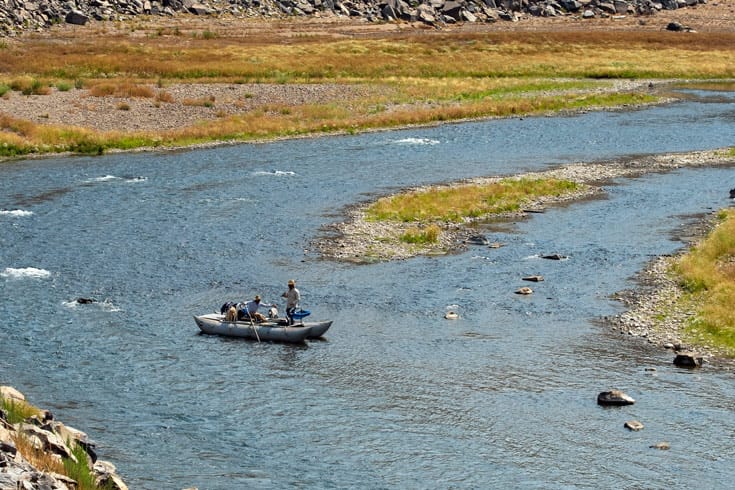
Story Spark: River Ecology
This week, we’re focusing on inland freshwater waterways, but climate change is causing problems for briny rivers as well through worsening saltwater intrusion. Check out our issue digging into how this “invisible flood” of saltwater impacts coastal communities around the world.
Freshwater rivers and wetlands cover less than 1% of the planet’s surface, but they’re home to 10% of all the species on Earth, many of which aren’t well studied. These ecosystems are particularly vulnerable to climate change’s impacts; a new study of US river systems finds that three-quarters of these ecosystems likely won’t survive or adapt to rising temperatures and shifting precipitation patterns. Some conservation biologists have described the ecological threat faced by the world’s rivers as a “silent mass extinction.”
River biodiversity around the world is declining for myriad reasons, many of which are amplified by the changing climate. Rising air temperatures warm waters, degrading livable habitats for cold water plants and animals. Warmer water holds less oxygen, creating freshwater dead zones, and make toxic algal blooms more likely. Water quality suffers again during droughts and floods because pollutants, heavy metals, and sediment are swept into rivers. And worsening and more frequent climate disasters, such as hurricanes and wildfires, further disrupt sensitive freshwater ecosystems by reshaping the surrounding landscapes.
When covering this story, speak to local fish and wildlife experts to better understand how river ecology is being affected in your area. Given the enormous diversity of freshwater species around the world, the changes will likely change region to region. For example, many freshwater fish, such as trout, need cool water to survive, but record heat has driven water temperatures to lethal levels around the US — from the highland rivers of Pennsylvania to the mountain streams of southern Appalachia and Montana. When covering this story, look for local initiatives to protect fish, wildlife, and build river resilience — the solutions being tested may surprise you.
– David Dickson, CCNow
Reporting Tips
This edition’s tips come to you from Alex Perri, a staff writer for The Smoky Mountain News in Waynesville, N.C., where she covers general assignment stories and healthcare. Perri recently reported on how warming temperatures, drought, and hurricane Helene have disrupted trout fishing in Southern Appalachia — a $2 billion dollar industry for North Carolina.
River folk make great subjects. Rivers and humans are constantly shaping one another, and I think there are infinite stories in that interface. Last year, I wrote about paddlers in North Carolina’s Green River Gorge for one of my grad school classes. The story started out focusing on a kayaking race, but it introduced me to a community of people whose relationship to the river was this primal, all-consuming thing. They were great sources as I fell down a rabbit hole and found a way into a Hurricane Helene anniversary story that both devastated me and expanded my understanding of humanity’s capacity for goodness.
Utilize Covering Climate Now resources and training programs. Before taking CCNow’s Climate Newsroom training, I probably would have stopped the scope of my story at the economic impact of the trout crisis without digging deeper into the climate connection. CCNow’s resource page was incredibly helpful — pointing me to SciLine, which helped me find a source specializing in Appalachian trout ecology on a tight deadline. Dr. J. Todd Petty provided the vast majority of the science for my story and helped explain it in a way readers (and I) could understand.
Tell the stories people want to know. While a lot of people in my coverage area say they don’t care about or believe in climate change, there is huge demand for answers on where the heck all the fish are at. The two are, of course, related, but this story had a wider reach because of the size of the trout industry in Western North Carolina.
Stories We Like
- In a thousand-mile journey from its source in the Colorado mountains to the banks of the river’s namesake state, Hatch Magazine explores what a warming world means for the Arkansas River and the people living along it.
- Alabama is home to more species of turtles, freshwater fish, and mussels than any other state. Vox examines how this epicenter of biodiversity is also gravely at risk, with Alabama also having more endangered and threatened animal species than almost anywhere in the US — and not enough money to help those most at risk of extinction.
- Yale Environment 360 highlights how Indigenous communities in northern Alaska are facing a growing challenge of “rusting rivers” as climate change is thawing permafrost, producing sulfuric acid that turns Arctic rivers orange.
- Farmers, fishers, and even beavers are working together to stop the deterioration of one of England’s most biodiverse marine habitats. The Guardian covers how these local initiatives are faring as warming waters make algal blooms more likely to occur.
- As climate change dries New Mexico, the Pecos River faces a growing threat as it runs through the middle of a “hellscape”: the Permian Basin oilfields. Capital & Main examines the multiple challenges faced by the plants and animals living in the shrinking watershed.
Resources
- Use the Nature Conservancy’s Resilient River Explorer interactive tool to evaluate freshwater rivers and watersheds in your area and across the US.
- Explore the USGS National Water Dashboard to find real-time data from more than 13,000 water monitoring stations located in rivers and streams across the country.
- Dig into how water quality has been impacted in freshwater streams, lakes, and wells across the US through the EPA’s freshwater explorer mapping tool.
- There’s a lot of scientific research into this topic. Read up on the latest studies, including this analysis of nearly 1,000 case studies on how river quality is deteriorating amid worsening climate extremes.
Experts and Sources
- Samantha Oliver, hydrologist, United States Geological Survey
- Jeffrey Todd Petty, dean of Warnell School of Forestry and Natural Resources, University of Georgia
- N. LeRoy Poff, professor, Colorado State University
- Anthony Ricciardi, professor, McGill School of Environment
- Michelle van Vliet, professor of water quality and sustainable water systems, Utrecht University
Before We Go…
The next Locally Sourced will explore and explain atmospheric rivers. These “rivers in the sky” are responsible for producing significant rain and snow, especially in the Western US, and are influenced by a warming atmosphere. Have you reported on these events, their climate connection, and how this year’s El Niño will amplify its impacts? Send them to us at local[at]coveringclimatenow[dot]org. We’d love to consider them for the next edition of Locally Sourced and our media trainings and social platforms.
Want more story ideas? Check out the Locally Sourced archive for more topics to explore, including AI data centers, coastal flooding, air transportation, and more.
Know someone who might be interested in this newsletter? Forward Locally Sourced to a colleague!
Support Covering Climate Now
We’re working to help journalists worldwide improve and expand their climate coverage. Meet our staff and learn more about CCNow.