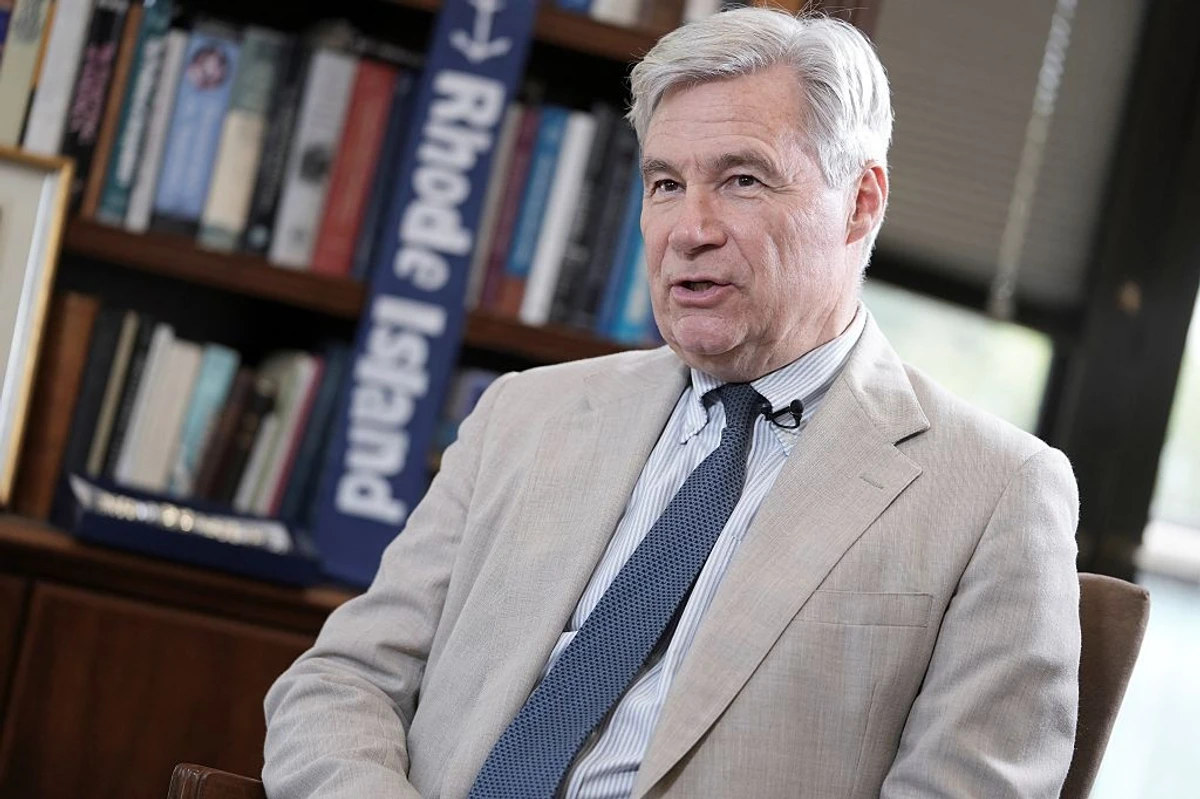
The Democratic Party and the climate movement have been “too cautious and polite” and should instead be denouncing the fossil fuel industry’s “huge denial operation,” US senator Sheldon Whitehouse said in a sit down interview this week.
“The fossil fuel industry has run the biggest and most malevolent propaganda operation the country has ever seen,” the Rhode Island Democrat told CCNow partners NBC News, AFP, and Bloomberg Green on Tuesday. “It is defending a 700-plus-billion-dollar [annual] subsidy … I think the more people understand that, the more they’ll be irate [that] they’ve been lied to.” But, he added, “Democrats have not done a good job of calling that out.”
Whitehouse is among the most outspoken climate champions on Capitol Hill, and on Wednesday evening, he delivered his 300th “Time To Wake Up” climate speech on the floor of the Senate.
He began giving these speeches in 2012, when President Barack Obama was in his first term, and has consistently criticized both political parties for their lackluster response to the climate emergency. The Obama White House, he complained, for years “wouldn’t even use the word climate and change in the same paragraph.”
Whitehouse said that after delivering 300 climate speeches on the Senate floor, he has learned to shift from talking about the “facts of climate science and the effects on human beings to calling out the fossil fuels’ massive climate denial operation.”
“Turns out, none of [the science] really matters while the operation is controlling things in Congress,” he said. “I could take facts from colleagues’ home states right to them, and it would make no difference because of this enormous, multi-billion dollar political club that can [punish] anyone who crosses them.”
Lawmakers need to recognize “how much [public] support there is for climate action,” he told CCNow partners. “How do you have an issue that you win 74 to 12 and you don’t ride that horse as hard as you can?”
Whitehouse said he was only estimating that 74 figure, but that’s exactly the percentage of Americans who want their government to take stronger climate action, according to the scientific studies informing CCNow’s 89 Percent Project. Globally, the percentage ranges between 80 and 89%.
Whitehouse is optimistic that climate denial won’t prevail forever. “Once this comes home to roost in people’s homes, in their family finances, in really harmful ways, that [will be] motivating in a way that we haven’t seen before around this issue,” he said. “And if we’re effective at communicating what a massive fraud has been pulled on the American public by the fossil fuel industry denial groups, then I think that’s a powerful combination.”
The above is an abbreviated version of CCNow executive director Mark Hertsgaard’s story based on the Senator Whitehouse interview. CCNow partners are invited to co-publish the full article, which can be found at The Guardian.
From Us
CCNow Newsmaker Interview: Sheldon Whitehouse. CCNow partners NBC News, Bloomberg Green, and Agence France-Presse jointly interviewed US senator and noted climate hawk, Sheldon Whitehouse on Tuesday.
Deadly consequences. Early reports indicate that the Trump administration budget cuts crippled the National Weather Service’s ability to warn residents about the oncoming flash floods that left over 100 people dead in Texas last week. Ultimately, science can only help save lives if government officials take that science seriously. By CCNow’s David Dickson and Mark Hertsgaard for The Nation…
Talking Shop: social media. Earlier this week, ABC News’ Ginger Zee and Oxford Climate Journalism Network’s Dr. Waqas Ejaz joined CCNow to talk about best practices in social-first journalism. Watch the video.
Noteworthy Stories

White Cliffs of Dover. Wednesday brought fresh evidence that the journalism news organizations are producing as part of CCNow’s 89 Percent Project is resonating with civil society around the world. Thousands of citizens descended on London to lobby Parliament as a gigantic image was projected onto the White Cliffs of Dover. By Damian Carrington at The Guardian…
COP30 agenda planning. “The possibility of sudden catastrophic change has been largely neglected in United Nations reports on the climate crisis, which allows politicians to carry on with business as usual. That must change in Belém,” writes Jonathan Watts in a must-read op-ed for Sumaúma…
Narrow window for action. Over 200 scientists attended a tipping points conference in Exeter, England, during a record-breaking heat wave last week that swept Europe. By Carbon Brief…
Context matters. It’s unclear how much of a role climate change played in the Texas flooding, but we know that climate change is making extreme-rainfall events more frequent and more severe. Many news reports included this “crucial climate context,” but many did not. By Jon Alsop in Columbia Journalism Review…
Dispatch #9 from the Climate Blueprint for Media Transformation
For several months, we’ve been periodically sharing standout insights from the Climate Blueprint for Media Transformation, a collaboration between CCNow and the Solutions Journalism Network. This is the ninth installment.
Do you believe even small impacts from your reporting, like someone sharing a story or signing up for a newsletter, are worth cataloguing? You should. Every step is valuable. That doesn’t mean journalists are always good at tracking all those “little” bits of success.
Tom Trewinnard helps newsrooms do that, and more. With his tips and resources, you can build that mindset into your work too.
Resources, Events, Etc.
The Yale Program on Climate Change Communication released a new installment of its ongoing national survey, “Climate Change in the American Mind: Beliefs & Attitudes, Spring 2025,” on July 8. Only 18% of Americans say they hear about global warming in the media “at least once a week,” the lowest percentage since the question was added to the survey in 2015.
The Reuters Institute for the Study of Journalism is hosting an exclusive webinar with Nic Newman, lead author of the just released Digital News Report 2025, who will present key findings on North America on August 7 at 12pm ET. RSVP
Jobs, Etc.
NatGeo is looking for a senior newsletter editor in Washington, D.C.; MarketWatch seeks an ambitious reporter to join its technology team to cover Elon Musk and his companies; the Arizona Republic is seeking two journalists for reporting fellowships on an ongoing grant-funded environmental project; and New Scientist is looking for an environment news reporter in the UK.
The Climate Change Media Partnership (CCMP), led by Internews’ Earth Journalism Network (EJN) and the Stanley Center for Peace and Security, is pleased to announce the COP30 CCMP Reporting Fellowship Program for journalists from low- and middle-income countries interested in covering COP30 in Belem. Deadline: July 15, 2025 Learn more.
Support Covering Climate Now
We’re working to help journalists worldwide improve and expand their climate coverage. Meet our staff and learn more about CCNow.
Editor’s Note: Correction. Senator Whitehouse spoke with CCNow partners on Tuesday, July 8.