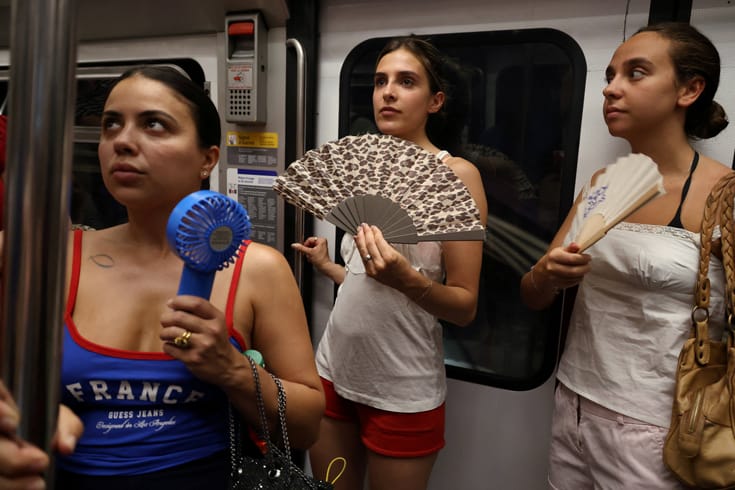
This week a brutal heatwave is shattering heat records in Europe, but it’s worth recalling that last summer the same thing happened in Asia. China, Japan, and Korea suffered their hottest summers on record in 2025, the World Meteorological Organization noted in a new report. Now, it’s France’s turn. And maybe Belgium, Spain, and Britain’s as well. As global warming driven mainly by burning fossil fuels continues to intensify, record heat will become increasingly frequent throughout the world.
Temperatures in France this week have been the hottest ever recorded, exceeding 44 degrees Celsius (112 degrees Fahrenheit) on June 23. French authorities placed more than half the country on “red alert” and warned that the extreme heat would continue for days to come, Agence France-Presse reported. The Guardian quoted the French health minister explaining that “Many people are going to suffer, because bodies suffer from an accumulation of high temperatures.” In the first of what will surely be more death reports, The Guardian shared the especially tragic news that “two children aged two and four have been found dead in their family’s car in south-eastern France.”
The intensity, scope, and projected duration of this extreme heat has drawn comparisons to the catastrophic heatwave that scorched Europe in 2003. That heatwave is a landmark event in the history of human-caused climate change for two reasons. First, it was the first extreme weather event that scientists authoritatively attributed to climate change; a team of British scientists published a study concluding that global warming was responsible for 45% of the excessive heat that punished Europe that summer. Second, the 2003 heat wave was global warming’s first mass casualty event: It killed a staggering 71,000 people in six weeks, considerably more than the number of US war deaths throughout all the years of the Vietnam War. (Initial reports estimated that 15,000 people died, a figure sometimes still repeated today, but subsequent epidemiological analysis concluded that the actual death toll was nearly five times higher.)
The current heatwave need not injure or kill that many people, and civic-minded journalism can help limit the suffering — by alerting the public to impending extreme weather and sharing tips for how to be safe, such as staying hydrated and checking on elderly neighbors. Much will also depend on the effectiveness of government policies and social infrastructure. Are authorities issuing clear weather alerts that reach everyone in harms’ way, including people living on the streets and speakers of non-native languages? Are there enough cooling stations where people who lack air conditioning can find temporary relief? Aware of these challenges since 2003, France and neighboring countries have implemented countermeasures; the current heatwave will test how well they perform under pressure.
The best news coverage of the June 2026 European heat wave has balanced how extreme heat impacts people’s daily lives with the larger scientific and social context: the fact that this kind of heat is exactly what scientists have long said would happen if humans continued burning fossil fuels, destroying forests, and otherwise pumping planet-warming gases into the atmosphere. In AFP’s June 22 story, headlined “Europe sweats through new heat wave, with worse to come,” the third paragraph plainly stated, “Scientists have shown that recurring heatwaves are a clear marker of global warming, primarily caused by burning coal, oil and gas — and warn they are set to become more frequent, longer, and more intense.”
But as with other recent extreme weather disasters, much of the coverage has omitted the climate connection. In 2026, given the advanced state of climate attribution science, that is simply not journalistically defensible. As my colleague Kyle Pope and I wrote in January 2025 after most coverage ignored the climate connection to the mega-fires that engulfed Los Angeles, “When a house is on fire, by all means let journalism show us the flames. But tell us why the house is burning, too.”
Unfortunately, there will be lots of opportunities to get this story right. The summer of 2026 is only just beginning, and a Super El Niño promises to further supercharge temperatures across much of the planet in the coming months, with North America due to swelter next week. Beyond that, as hot as 2026 is in Europe and 2025 was in Asia, in the future these will be seen as some of the coolest years in people’s lifetimes. The science is unequivocal: Until fossil fuels are phased out, global temperatures will keep going up and up and up. What our civilization decides to do about that fact, though not much discussed these days, is among the most consequential questions of our time.
From Us
Radar Clima: Cómo cubrir la migración y los desplazamientos climáticos. La última edición de Radar Clima, nuestro boletín en español para periodistas de todas las áreas, te trae datos clave, recursos y ángulos de cobertura para reportear uno de los fenómenos más complejos de la crisis climática en América Latina, Estados Unidos y España. Échale un vistazo a las ediciones anteriores y suscríbete para recibir el boletín los miércoles.
Noteworthy Stories
Rightwing shift. Abelardo de la Espriella, a Trump ally and fracking advocate, appears to have won the presidential election in Colombia. His victory represents an about-face from the policies of outgoing President Gustavo Petro, who banned fracking, halted oil and gas exploration licenses, and co-hosted the first conference on transitioning away from fossil fuels in April. By Katie Surma for Inside Climate News…
Funding restored. In a rare move, a bipartisan group of US senators passed legislation prohibiting the Trump administration from dismantling a multimillion-dollar research project studying ocean currents and climate change impacts. But many other programs crucial to understanding climate change remain at risk. By Sachi Kitajima Mulkey for Grist…
Slowing down. AI data centers’ high energy and water demands are slowing the green energy transition in the US. This explainer digs into their climate and environmental impacts. By Samantha Harrington for Yale Climate Connections…
Homeschooling. Working women across India are quitting their jobs in order to stay home with their children as more schools go virtual because of extreme heat. By Arsalan Bukhari and Naila Tabbasum for The Guardian…
“Wedges” exposed. Newly uncovered documents reveal that the British oil giant BP funded and shaped one of the most influential climate studies on record. Published in Science in 2004 by two social scientists at Princeton University, the “Wedges” paper argued that “the climate problem” could be solved with existing technologies (that did not actually exist) — while continuing to burn oil, gas, and coal. By Abrahm Lustgarten and Amy Westervelt for ProPublica and Drilled…
The Cordoban way. Residents of Cordoba, Spain, have a lot of experience with extreme heat. Other cities unused to high temperatures could learn from the measures Cordoba has taken, including stopping outside work in the afternoons and health monitoring for at-risk groups, depending on the severity of the heat alert. By Carmen Reina for Cordopolis…
Quote of the Week
“To see temperatures like this in the UK in June is sobering. Events like this bring home the implications of climate change, with very high temperatures and humidity bringing significant health implications from heat stress, as well as impacts to a range of sectors such as transport, energy and water supply.”
– Professor Stephen Belcher CBE, UK Met Office Chief Scientist
Resources & Events
- Climate.us launches (formerly climate.gov)
- “Santa Marta Conference: Final Outcome Report Shows Strongest Global Support to Date for a Fossil Fuel Treaty” (Co-hosted by Colombia and The Netherlands)
- “Project Cosmos, the world’s largest database of climate change research” (Carbon Brief)
- “As heatwave sweeps Europe, study warns of growing toll on household incomes” (Climate Analytics)
- “Nearly half of the world’s children exposed to at least three overlapping climate threats” (UNICEF)
- “How much deforestation is your country importing through trade?” (World in Data)
- RSVP: “Climate Change and Energy in the Indonesian Mind: Key Public Opinion Findings” with Yale Program on Climate Change Communication, on Monday, June 29, at 9pm US Eastern Time (1am UTC)
- RSVP: “Fuel on Fire: Reporting El Niño and the True Costs of Climate Change” with 350.org, on Wednesday, July 8, at 11am US Eastern Time (3pm UTC)
- RSVP: “20 years of DeSmog: A celebration of high-impact climate journalism” with DeSmog, on Wednesday, July 8, at 3pm US Eastern Time (7pm UTC)
Missed Connections
Once again, The Washington Post failed to make the climate connection in its coverage of the heat dome bringing sweltering temperatures to central Europe earlier this week.
It only takes one or two lines — at the very least — to make the connection. As the UK Met Office pointed out in its amber warning: “It is virtually certain that human influence has increased the occurrence and intensity of extreme heat events. Numerous climate attribution studies have shown that human influence increased the chance that specific extreme heat events would occur, such as the summer of 2018 and July 2022.”
Kudos to Deutsche Welle’s Jennifer Collins for her article that highlighted the connection in the headline, “European heat wave is not normal summer weather,” and Sabine Kinkartz’s article on its economic costs, “Climate change: Heatwave costs the German economy billions.”
On the Beat
https://bsky.app/profile/leohickman.carbonbrief.org/post/3mozp75zccs27
A recent survey of British journalists revealed that, even though they think that climate change is the third most urgent topic to cover (behind cost of living and the economy), due to competing newsroom priorities, they are not covering it commensurately.
Jobs, Etc.
Jobs. CTV Your Morning Winnipeg is hiring a weather anchor (Winnipeg, Canada). The Times-Picayune/The Advocate is hiring an Environmental Reporter (New Orleans, La). Earth Journalism Network is hiring a Media Manager (remote, US). Our World in Data is hiring for a Writer (remote). STAT is hiring a Trust-in-Science Reporter (Boston, Mass.) Grist and KERA are hiring a Climate, Energy, and Environment Reporter (Dallas, Texas). The World is hiring a Show Editor/Producer (Boston, Mass.) The New York Times is hiring a Climate Policy Correspondent (Washington, D.C.).
Fellowships. The 2026 EJN Biodiversity Fellowship is accepting applications from young journalists interested in attending the UNCBD COP17 in Yerevan, Armenia; apply by June 29, 2026. ProPublica is accepting applications from local newsrooms to host a Local Reporting Network Fellow (consult map for eligible states); apply by July 27. Inside Climate News is accepting applications for its fall 2026 fellowship; apply by August 15.
Awards & grants. European Science Journalist of the Year is accepting submissions; apply by June 30. The Council for the Advancement of Science Writing is accepting submissions for its Evert Clark/Seth Payne Award for a Young Science Journalist; apply by June 30. The Journalism Institute at the National Press Club is accepting submissions for the Pamela Tobey Award for Excellence in Visual Storytelling; apply by July 20. The Net Zero Institute is sponsoring a contest for writers working on a fictional story or series that imagines a regenerative future; apply by August 30.
Workshop. Internews’ Earth Journalism Network is accepting applications for a media workshop on biodiversity reporting in Kenya; apply by July 11, 2026.