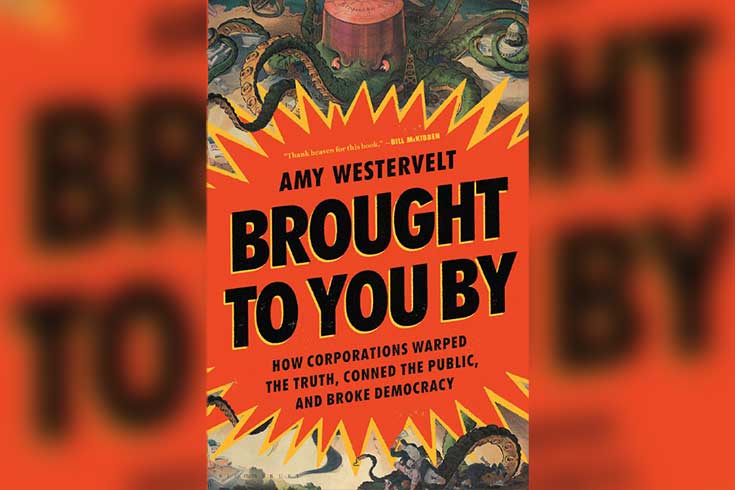
We live in a time, journalist Amy Westervelt laments in her new book, Brought To You By, when “millions of people have been convinced that it is patriotic to be antidemocracy [and] that doctors are not to be trusted but podcasters are.” In theory, democracy calls for citizens to inform themselves and contending points of view to be fairly debated. If that ideal of democracy were a reality today, government policies on climate change (and many other issues) would be very different, given that 80 to 89% of the world’s people want their governments to take stronger climate action.
The chaotic media landscape doesn’t help. Most people in that 80 to 89% super majority actually think they’re a minority: After all, that’s the message they get from news and social media, where “climate hushing” and climate denial are pervasive. It’s hard for the public to live up to democracy’s credo when they are engulfed by a ceaseless avalanche of information, much of it unreliable, misleading, or false.
How did we get here? And what can be done about it? Amy Westervelt began grappling with these questions while reporting groundbreaking exposés of the fossil fuel industry’s efforts to hide and deny the scientific fact that its products dangerously overheat the planet. (Disclosure: Westervelt is on the steering committee of CCNow.) Brought To You By tells what Westervelt presents as the origin story of Big Oil’s deceptions. It’s a deeper story that must be reckoned with, she argues, in order to comprehend today’s dizzying information system and replace it with a system that serves democracy and, with it, climate survival.
A self-described “history nerd” whose “happy place” is inside library archives, Westervelt opens her narrative by recounting how the American Petroleum Institute, the oil industry’s US trade association, came into being.
During World War I, a PR man named Ivy Lee worked behind the scenes to get oil companies to cooperate rather than compete and thus ensure a steady supply of oil for the war. “As the war drew to a close,” Westervelt writes, “Lee thought … if normally competing companies could coordinate on production and supply during the war, why not work together in peacetime to keep prices high and regulation low?” The American Petroleum Institute’s first official meeting took place in Washington barely six months after the fighting ended.
Lee and his colleague Edward Bernays are now regarded as the fathers of modern public relations. Although they pioneered the use of press releases and other now common techniques, their fundamental innovation was to play offense. Instead of avoiding the press, as companies traditionally had done, Lee and Bernays gave the press the stories that they wanted told. Their clients in the oil, coal, railroad, auto, tobacco, and chemical industries duly saw their preferred versions of reality reflected in the news that the public and policymakers heard.
Westervelt details how the pivotal insight of playing offense gave rise over the ensuing century to a globe-straddling system of “information pollution.” Today, she argues, PR is the delivery mechanism for messaging that draws on “university research co-opted by corporate funding and further eroded by think tanks,” such as the Heritage Foundation, which authored the Project 2025 blueprint that the second Trump administration has sought to implement. Fox and other right-wing media outlets “have been used to normalize it all,” she adds, and “technology has flooded the zone and made it impossible to get away from.”
“Bullshit,” she declares when demolishing the counter-argument that these monied interests are simply exercising their right to free speech. She notes that US Supreme Court justice Oliver Wendell Holmes’s landmark opinions distinguished between “the right to speak,” which should be protected, and “the right to mislead,” which shouldn’t. But a century later, that distinction was erased by the Supreme Court’s 2010 Citizens United ruling, which equated money with speech and, in Westervelt’s words, “gave corporations the right to shout over everyone else.”
One anecdote in her book resonates with a more philosophical argument about the environmental crisis presented in journalist Jason Dove Mark’s new book, The Earth Said Remember Me: How to Restore and Sustain a Livable Planet. Mark explores a concept that scientists call “shifting baseline syndrome.” In a world of rapid change, humans often don’t realize that today’s environmental conditions are quite different — usually worse — than past conditions. He uses the example of monarch butterflies, whose miraculous migrations from Mexico used to paint trees in California orange with their density but which, in recent years, have dwindled to almost nothing. When novice observers took comfort in sighting some monarchs in their yard, a veteran monitor of the butterflies’ migrations asked, “Like, tens of thousands?” No, the novices replied, only “a few.” The monitor asked, “Do you remember when you used to see ten thousand?”
Collective amnesia about deteriorating conditions is also seen in social systems. Just as it’s become hard “to remember what summers were like before the nonstop sizzling heat” of recent years, Mark writes, it is now difficult “to remember social life before social media…. [And] the once-outrageous — the bilious, hateful rhetoric and the creeping authoritarianism — have become almost ordinary.”
Westervelt quotes a university professor who unknowingly proves the point. Teaching an undergrad class on media and politics, the professor asked her students to cite their sources. “Their answers were things like Twitter or Instagram or TikTok,” she recalls. “And I said, ‘No, no, I don’t mean where you saw it. I mean the original source.’ And they really didn’t know what I was talking about.”
Westervelt hastens to add that if people are confused it is “not because they’re idiots —they’re not!” It’s because they’ve never been taught to think critically about how “the information around them is being shaped by forces they don’t see.” She singles out “the tech bros [who], armed with algorithms and data, take Lee’s quote about facts being open to interpretation and turn it into millions of splintered realities” and thus wage “an information war against their own people.”
Real journalism — the rigorous, fair-minded gathering of facts and the public distribution of a coherent narrative — is an antidote to the confusion fostered by today’s information pollution. This September 28, hundreds of the world’s news organizations will mark World News Day by proclaiming “A single message: Trusted journalism matters.” That message, like Earth Day’s, is one that deserves attention every day of the year.
From Us
RSVP: Rising Energy Bills, Climate, and the 2026 Midterms. Join CCNow and Canary Media next Wednesday, September 16, at 3pm US Eastern Time, for a timely conversation about the energy affordability crisis in the US. Join Savannah Harriman-Pote of Hawaiʻi Public Radio, Charles Hua of Powerlines, Dr. Leah Stokes of UC-Santa Barbara, and Julian Spector of Canary Media for this live conversation.
RSVP: Seminario web ‘El Niño en América Latina: qué viene y qué historias podemos contar.’ Participa en el seminario web organizado por Covering Climate Now y Fundación Gabo: qué viene y qué historias podemos contar para conversar con científicas, científicos y periodistas especializados en clima sobre el cubrimiento de este fenómeno y cómo construir historias con impacto.
RSVP: Journalism Is an Effective Climate Solution. Join CCNow for a live, in-person conversation about how journalism is an effective climate solution on Monday, September 21, at the Narrative Change Summit during Climate Week NYC, hosted by Climate Film Festival.
Noteworthy Stories
Climate justice. Nepal’s government petitioned the UN loss and damage fund for $20 million in climate compensation for the August floods that left more than 6,000 people lost or dead, calling the disaster a “wake-up call” for the global community. By Hannah Ellis-Petersen for The Guardian…
“Super-sized” El Niño. Last week, the World Meteorological Organization issued a warning predicting a “nearly 100% likelihood” that El Niño will last through February. This El Niño will be so big, “with consequences that are so large, I’m not sure we fully understand them,” says climate scientist Daniel Swain. By Molly Taft for Wired…
“Carbon bomb.” Thousands of volunteer firefighters, many of whom are Indigenous Dayak or Banjar people, are battling an enormous wildfire in one of the world’s biggest tropical peatland ecosystems this summer in Borneo. By Gavin Butler and Ahmad Dhani for the BBC…
ER visits increase. Climate change was responsible for 27% more heat-related US emergency room visits in 2018–2025 than there would have been without it, according to new research from Climate Central. By Jeva Lange for Heatmap News…
Un-affordability. Many of New York City’s heat-related deaths between 2016 and 2025 occurred inside their homes, according to a new city government report. “Owning an air conditioner isn’t enough, because some people can’t afford to use them,” observed one cooling center official. By Lauren Dalban for Inside Climate News…
On the Beat
The public is, largely, still not making the connection between climate change and extreme weather events, especially heavy rainfall. At the same time, “fewer journalists are doing the kind of reporting that could help close this gap.” Something’s got to give. By Kiley Price for Inside Climate News…
Quote of the Week
“If one city discovers a better way to protect outdoor workers, cool public spaces, or communicate risk to residents, others should not spend years reinventing it. Good ideas should travel.”
– The mayors of Paris, Milan, and Phoenix in Guardian op-ed
Resources & Events
- “New report finds tackling climate change and air pollution together could save trillions” (UN Environment Programme)
- Trade and Climate Tracker: How recent bilateral and plurilateral economic agreements support, structure, or constrain the green transition (International Institute for Sustainable Development)
- “The Legal Planet Guide to Suncor Energy v. County Commissioners of Boulder County” (Legal Planet)
- “Managing Heat Risk: Crop Insurance and Rural Economic Resilience” (Resources for the Future, US)
- “As El Niño looms, study finds rapid growth in climate extremes are hitting an unexpected region of the Amazon hardest” (Communications Earth & Environment)
- “How this summer’s heat and drought impacted crops in Europe – in six charts” (Carbon Brief)
Jobs, Etc.
Jobs. Sentient is hiring a Food and Farming Storytelling Fund Program Manager (remote, two-year term). Bloomberg is hiring a Team Leader – Climate and Nature Data (New York, NY). The New York Times is hiring a Correspondent, The Economics of a Warming World, an Audience Editor, Climate and Science (New York, NY), and a Climate Policy Correspondent (Washington, DC). Semafor is hiring an Asia Editor (remote, ideally Singapore). Spectrum News is hiring a National Meteorologist (Dallas, Texas).
Fellowships, Tours, Grants & Pitch Opportunities.
- Green Central Banking is accepting pitches from journalists in the EU, UK, or Southeast Asia about monetary and public policy issues related to climate change and the energy transition.
- Earth Island Journal is accepting pitches.
- Clean Energy Wire is offering European journalists the opportunity to attend a two-day research tour, Anticipating Europe: Foresight and the next generation of EU reporting, in Brussels September 28–29.
- Evident is accepting applications for a year-long investigative journalism fellowship beginning October 2026 based in the Baltimore/Washington, DC area; apply by September 22.
- The Vital Impacts Environmental Photography fellowship and mentorship program is accepting submissions for long-term visual storytelling projects related to communities working on environmental solutions; apply by November 30.
- The Pulitzer Center is offering Work/Environment Reporting Grants with a particular interest in reporting from regions in Southeast Asia, Europe, Africa, and South America.