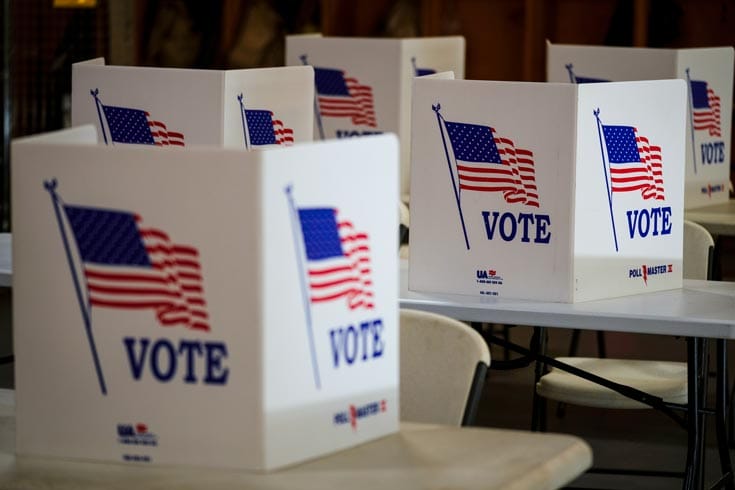
“Are you part of the 89%?”
A team of Covering Climate Now reporters traveled through eastern Pennsylvania last week asking people that question, exploring what residents of that quintessential battleground state think about climate change and the fast-approaching US midterm elections. Pennsylvanians had just endured a brutal heatwave that scientists said would have been “virtually impossible” absent global warming. Temperatures in Philadelphia hit 103 degrees Fahrenheit, leading authorities to cancel the Fourth of July parade.
Pennsylvania is central to Democrats’ hopes of winning the US House of Representatives in November and putting a brake on Donald Trump’s one-party rule. Four of the 35 seats that Democratic strategists have identified as opportunities to flip from red to blue are in Pennsylvania. Trump won the state by a narrow margin in 2024 — a mere 120,000 votes out of 7 million cast — and his underwater approval ratings today figure to bolster Democrats’ chances.
Our 89% question referred to the 80 to 89% super-majority of people around the world who want their governments to “do more” about climate change. That’s according to the annual Gallup World Poll, as analyzed by scholars in the eminent scientific journal Nature Climate Change. Separate studies by Oxford University, the European Commission, and others found similar levels of support. Crucially, the studies also found that the super-majorities in most countries do not realize they are a super-majority; instead, they think they are a minority.
Shedding further light on Pennsylvanians’ views, the Yale Program on Climate Change Communication recently released survey data measuring Americans’ views about global warming and what they think governments and corporations should do about it. The data covers the entire US but is also broken down by state, county, and congressional district. For example, 63% of all Americans are “somewhat worried” or “very worried” about global warming, whereas the number in Pennsylvania is 61% and in neighboring New Jersey it is 71%.
Launching the next phase of reporting in CCNow’s 89 Percent Project, our interviews with a diverse collection of Pennsylvanians broadly confirmed these findings, with important caveats. For example, Joe, a retired schoolteacher in Philadelphia, wanted stronger government climate action himself but believed that only “15 to 20%” of people felt the same way. (To protect the privacy of people’s voting preferences, this article will not use the last names of interviewees.) “Maybe we’re not doing a good enough job of communicating the dangers for people’s kids and grandkids,” he added.
To be clear, the size of the climate super-majority varies by country. In the US, the percentage is lower, at 74%. No surprise, really, considering that the US is the world’s oldest petrostate and currently the largest producer of oil and gas. (And Pennsylvania, in fact, plays an important role in that history: The world’s first oil well was drilled there, in 1859.)
In Pennsylvania, according to the Yale data, 59% say that the US economy should transition to 100% clean energy by 2050, and 53% say that “a candidate’s views on global warming are important to my vote.” If a meaningful fraction of these people vote accordingly in November, the climate majority could have a decisive effect on the results.
“Absolutely, I am,” said Emily, a 30-ish office worker in Allentown, when asked if she was part of the 89%. Climate change is one of her priority issues, and, she added, “absolutely I will be voting in November.” Of Mexican heritage, Emily said some of her family members are not authorized to vote. “If you have the ability to vote, definitely vote,” she urged. “If not for yourself, at least vote for those who can’t.”
Camille, a Black single mother in Allentown, said she wants the government to do more about climate change, partly because of her children, ages 10 and 12. Underscoring the importance of the affordability theme many Democrats are emphasizing this year, she added, “but I want the government to do more about a lot of things, especially the cost of living. People are struggling, and in a country as rich as this, people should not be struggling.”
Along with Scranton, Allentown is one of two sizable cities in Pennsylvania’s 8th congressional district, one of the four seats Democrats aim to flip in November. Located 63 miles north of Philadelphia, Allentown is currently represented by Republican Rob Bresnahan, who ousted an incumbent Democrat in 2024 by an even slimmer margin than Trump’s.
The Yale data indicate that 59% of the district’s residents are “worried” about global warming, the same percent that wants the US to transition to clean energy by 2050. And like Pennsylvania as a whole, 53% of 8th district residents say a candidate’s views on global warming are important to how they vote. The numbers are very similar next door in the 9th congressional district, even though the 9th is home to some of Pennsylvania’s fracking operations.
The 8th is a swing district partly because it has lots of voters like Bobby, a white-haired computer systems manager who saw no urgency in addressing climate change. “I think climate change is real; we can feel that the weather is hotter than it used to be,” he said. “But,” he believes that, “burning fossil fuels only has an incremental effect on it. We should be stewards of the earth and make incremental improvements, but they’ll be incremental.” Roughly one out of three people (32%) in the 8th district likewise believe that global warming is not much affected by human actions.
Jose, a warehouse worker in Allentown, agreed that the weather had been “very hot,” but he had never heard the terms “climate change” or “global warming.” When they were explained, he waved them away with a smile, saying, “This is in God’s hands.”
God’s will was invoked in more than a few of our interviews, a reminder of how powerful a role religion plays in public attitudes in the US. More than one out of three (37%) of Americans reject the science of evolution, believing instead that “God created humans in their present form in the last 10,000 years,” a 2024 Gallup poll found. “I never heard of global warming, but it don’t matter,” said Rodney, an older African American man hawking ice cold bottles of water across from Independence Hall in Philadelphia. “It’s all up to Jesus. And you better get right with Jesus, or you’ll end up in a place a lot hotter than this.”
Although a clear majority of the people we interviewed in the purplish 8th district and in bright blue Philadelphia said they favored stronger government climate action, there are significant caveats. Many of these individuals did not seem to hold this opinion very strongly; they had only a vague understanding of what climate change is and how it could be tackled; and they were not necessarily planning to vote in November.
Liz, a middle-aged retail clerk in Plymouth Meeting, a smaller town 20 miles north of Philadelphia, said the July 4th heatwave was “terrible” and that it was “probably” made worse by climate change. She plans to vote in November, but she said that “most people around here don’t care about that stuff, and they don’t vote.”
James, a security guard in Plymouth Meeting, said the July 4th heat was “really bad. I heard on the news it was the hottest it had been in 100 years.” Did he think global warming was to blame? “I don’t know. They used to talk about that more, but I haven’t heard much about it lately.”
James’s comment aligns with one of the most striking findings in the Yale survey: 84% of people in the 8th district and 82% in Pennsylvania as a whole said they only heard about global warming in the media once a month at most. Some major US news organizations have retreated from climate coverage recently; the TV networks ABC, CBS, and NBC reduced the airtime they devoted to climate change by 35%, according to the watchdog group Media Matters. This retreat, however, runs counter to what audiences say they want. A separate study released this month by the Yale Program on Climate Change Communication found that 74% of Americans say “they are interested in news stories about global warming.”
Kennedy, an African American educator from Tennessee who was touring Philadelphia with his wife to mark the US’s 250th birthday, was not surprised that a sizable minority of people don’t care about climate change. “What the media says is very important,” he said. Referencing the roughly 25% of the country who he estimated reject climate science, he added that, “People need to have an honest assessment of what’s going on with their world if they’re to have informed opinions.”
Only one person among the dozens we interviewed correctly guessed the percentage of Americans who favored stronger government climate action, and her method was grounded in a similar insight. CCNow conducted our Philadelphia interviews alongside Susan Phillips, the veteran environment reporter for the local public radio station WHYY. Near an outdoor World Cup viewing party the city had organized, Phillips put this question to Amanda, a middle-aged white woman on a bicycle: What percentage of people do you think want their elected representatives to do more about climate change? Amanda paused and replied, “75%.” It was simple math, she explained. MAGA is 25% of the country, so “America minus MAGA is 75%.”
From Us
Apply: Covering Climate Now Academy. We’re now accepting applications for our free three-month training program that runs from September to December 2026. With 40 slots available, become a part of a global community and learn climate science basics, how to practice solutions journalism, how to spot disinformation, and much more. Apply by August 11.
RSVP: CCNow Basics: Three Pillars. Join us on Wednesday, August 12, at 10am US Eastern Time (2pm UTC), for a training session on CCNow’s Three Pillars approach to covering climate change: humanize, localize, solutionize. All journalists, especially early-career reporters, are invited!
Radar Clima: El impacto que no vemos: clima y salud mental. En la última edición de Radar Clima, nuestro boletín en español para periodistas de todas las áreas, exploramos los impactos de la crisis climática sobre trastornos como la depresión, el estrés crónico, o el estrés postraumático entre otros. Explicamos por qué no toda ansiedad es patológica, y cómo involucrarse en acciones por el clima es un buen antídoto. Échale un vistazo a las ediciones anteriores y suscríbete para recibir el boletín los miércoles.
Meet us in NOLA! Next week, CCNow’s Elena González will be speaking at the National Hispanic Journalists Association conference in New Orleans. She’ll be on the panel “Meet them where they are: digital strategies to cover climate for social media audiences” on Wednesday, July 22, at 9:45am CT. Come say hi!
Noteworthy Stories
Europe is burning. Wildfires are raging across Europe, and officials are warning that the record set last year — when 228,000 hectares burned in the EU — may be beaten this summer. By Pierre Breteau for Le Monde…
Heat deaths. Early indications are that Europe’s multiple late spring and early summer heatwaves were responsible for thousands of excess deaths, though it will take many months to more accurately assess the heat’s death toll. In Britain alone, officials say that more than 2,700 people in England and Wales died from heat-related causes. By Amelia Nierenberg for The New York Times…
Brackish water. Farmers in Gambia are losing valuable cropland to salt water intrusion, a climate impact stemming from less rainfall and rising seas in many coastal farming communities around the world. By Phred Dvorak for Inside Climate News…
Courting climate. The Global South is disproportionately affected by climate change impacts, yet accounts for only 10% of active worldwide climate litigation. But more frequent extreme weather events, shrinking space for activism, and slow government action are driving communities across Asia to the courts. By Gaea Cabico for The Xylom and Grist… (Note: This story is republishable for partners, via our Sharing Library.)
Pump it up. Americans appear to have fallen in love with heat pumps. Over the past year, sales have doubled, and in the first quarter of 2026, they outstripped fossil fuel furnace sales by 32%, and nearly beat air conditioner units. By Matt Simon for Grist… (Note: This story is also available in CCNow’s Sharing Library.)
Chart of the Week
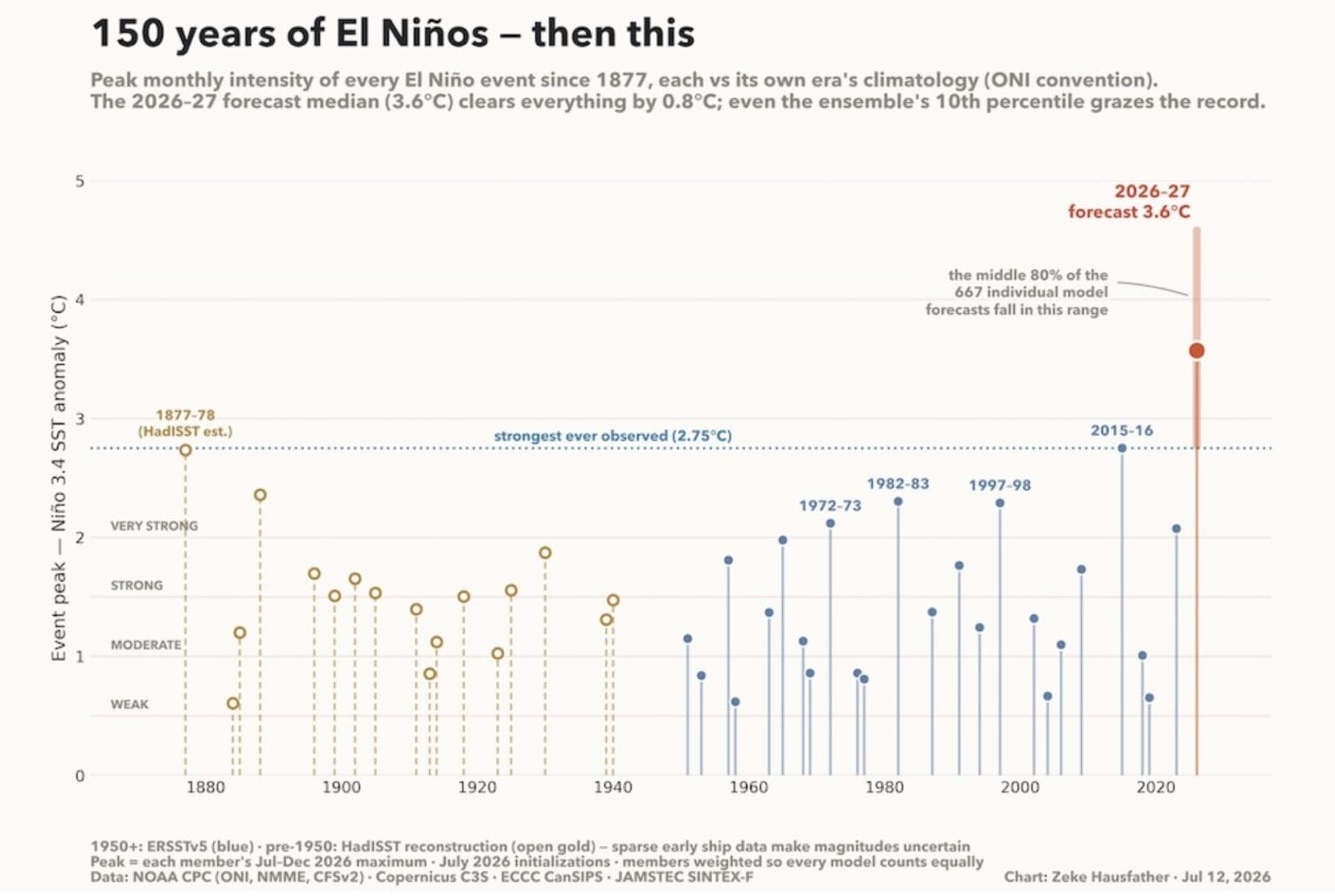
“With the July runs now in from 667 ensemble members across 14 different seasonal forecast models, it looks like this year’s El Niño is not only very likely to be the strongest event since reliable records began — it may end up the strongest by a truly mind-blowing margin.”
– Zeke Hausfather, a climate scientist, quoted in “This could be the strongest El Niño on record” (Yale Climate Connections by Bob Henson)
Missed Connections
Nearly three quarters — 72% — of stories about the June heatwave in the UK press didn’t mention climate change, according to new analysis reported on by The Guardian’s Fiona Harvey. Even fewer stories connected the deadly heatwave to phasing out fossil fuels and stopping climate change, and fewer than one in 20 heatwave stories mentioned the words “net zero.”
Gareth Redmond-King, head of international at the ECIU thinktank, said: “The link between all three recent periods of extreme heat and climate change is indisputable.”
He added: “If recent heatwaves are the symptom, then climate change is the illness, and net zero is the medicine. When public understanding of this link is so low, it’s vital that the dots are joined between these three concepts to help make us all better.”
Climate scientist Katharine Hayhoe posted on LinkedIn that missing the climate connection in stories is a widespread problem. On Monday, she counted nine US and Canadian stories in her newsfeed about climate impacts; only one mentioned climate change.
Resources & Events
- “Support for climate and biodiversity policies differs across cultural worldviews in Japan” (Communications Sustainability)
- “Residents near small rivers in the USA could face disproportionately high future flood risk” (Nature Sustainability)
- “Taming Data Center Turmoil,” a series of reports from Climate Cabinet Education offering state-level US lawmakers policy ideas for regulating hyperscale data centers
- “Fixing Climate Communications: Moving beyond narrow narratives to power durable progress” (Potential Energy and The Rockefeller Foundation)
- “Extreme weather event attribution predicts climate policy support across the world” (Nature Climate Change)
- Training: “Reporting from the Margins” is a free, four-session journalism course offered in English by Unfiltered, a small, journalist-owned cooperative, focusing on covering marginalized communities in Japan, is offering a free, four session journalism course
- RSVP: “Can This Climate Policy Actually Work? Learn How to Test It with En-ROADS,” hosted by Climate Tracker Asia and Climate Interactive, on Tuesday, July 28, at 9am Jakarta time, and Thursday, July 30, at 5pm IST
Jobs, Etc.
Jobs. The Texas Tribune is hiring an Immigration, Environment and Climate Editor (Texas). CalMatters and Grist are hiring a Climate Reporter (remote, Central Valley, Calif.). Mongabay is hiring a Managing Editor – Africa (English), an Associate Editor – Story Transformer, and a Senior Video Story Editor (all remote). The University of Chicago Institute for Climate and Sustainable Growth is hiring a Communications Specialist, Science and Technology (Chicago, Ill.). NPR’s Science Friday is hiring an Associate Producer, Audio (remote or NYC). ProPublica is hiring a California Reporter (remote, California). The Times-Picayune/The Advocate is hiring an Environmental Reporter (New Orleans, La.).
Fellowships & Grants. Climate Tracker and Oxfam are offering five $500 reporting grants for stories about women and just transition in Latin America, and offer editorial support. Grants are available to journalists from Guatemala, Honduras, El Salvador, Mexico, Colombia, Peru, Bolivia, and Brazil.
Freelance. Dialogue Earth is accepting pitches for photo and social-first stories on heat solutions in the Global South.