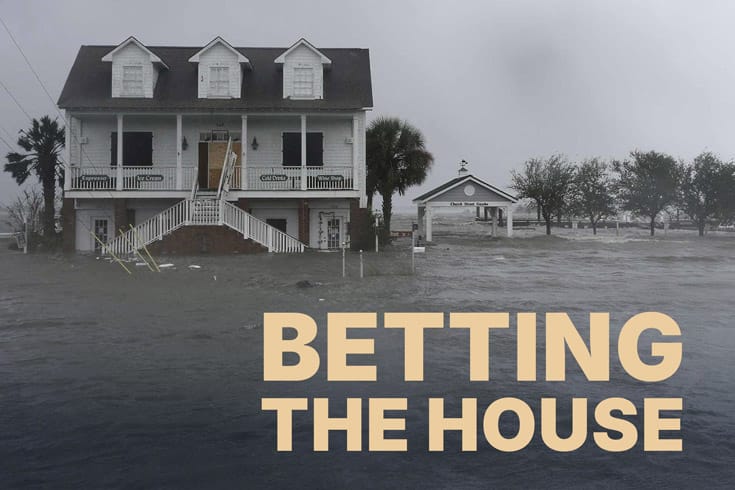
Betting the House is a pop-up collaboration of journalists reporting on what the climate crisis means for the places we call home. As extreme weather events become more frequent and severe, the questions around where we live, and how it will be affected by a warming planet, become more pointed.
In this series, four independent climate journalists based in the US have joined together to simultaneously report the story of housing and climate change — from different states, with different angles, for different media. They are Emily Atkin, Editor-in-Chief of HEATED (formerly The New Republic); Chase Cain, Correspondent for Chase What Matters (formerly NBC News); Rachel Ramirez, Founder and Editor of The Confluence (formerly CNN); and Ben Tracy, Senior Climate Correspondent for Climate Central (formerly CBS News). Tracy Wholf, Executive Producer for WereWHOLF Media (formerly CBS News and ABC News), produced the project.

Covering Climate Now has advised and supported this effort in part because we believe that how the climate crisis is impacting housing is both of paramount importance and underreported. But we also see this pop-up collaborative as a blueprint for what could be a new kind of independent journalism, as big outlets deprioritize climate by laying off reporters, shuttering desks, or failing to make time on air. Journalists who contributed to Betting the House, most of whom have worked for some of the country’s biggest newsrooms, are intimately familiar with that dynamic.
Working separately, but in tandem, could be a path to finding new audiences — each other’s — and amplifying the reach and impact of your good work. We invite you to read and watch the work in this project, share it, and consider pop-up collaboratives of your own. And let us know if you were inspired by this project.
If you’d like to learn more about this reporting collaborative and how they did their work, reach out to Tracy.
Covering Climate Now hosted a live conversation with the journalists about the project, hosted by Tracy Wholf on Thursday, September 24. Check it out.
The Open House at the Edge of Disaster
Emily Atkin, HEATED

MIAMI — I am not meant to be in Miami in August. The thick air, the searing cement, the tepid ocean—it’s all teaching me what scientists mean when they say some places are becoming too hot for the human body to survive. Is Miami technically one of those places? No. But my dripping knee pits don’t care about technicalities. I hate it here. I want to leave.
Unfortunately, I have traveled to Miami with exactly one job: to pretend this is where I want to live forever. Read the rest of Emily’s piece on HEATED.
Too Attached to Leave
Chase Cain, Chase What Matters
NEW ORLEANS — New Orleans is sinking, sea levels are rising, and the cost of home insurance is soaring. But it’s not just a problem for the Louisiana coast, plenty of towns across America are becoming uninsurable — especially in Florida, Texas, California, and North Carolina.
A U.S. senator told me the national home insurance crisis could trigger a 2008-style recession. So I went to New Orleans to ask an unavoidable question: who decides which communities we protect? And who gets left behind? Is it time to plan a managed retreat from Louisiana, or can we engineer a way to save America’s most vulnerable cities before time runs out?
Watch Chase’s piece and subscribe to Chase What Matters.
Buying on the Brink in Hawai’i
Rachel Ramirez, The Confluence

HONOLULU — Walking the stretch between Sunset Beach and Rocky Point on O’ahu’s North Shore today means choosing between a violent shoreline that could sweep you away, or climbing the top of giant geotextile tubes filled with sandbags called “sand burritos,” installed by property owners as temporary makeshift barriers to fight coastal erosion.
Standing on a sandbar separating the murky Pa’amalu stream from the sea, Denise Antolini and I paused to watch a pregnant woman and her husband precariously cross atop these massive “sand burritos” covered in black fabric. We waited for them to pass before we set off in the opposite direction. One misstep, and you might just fall down the steep embankment onto the shrinking strip of the shore below. Read Rachel’s piece on The Confluence.
For republication, please credit the author and The Confluence with the following language: “This story was originally published by The Confluence as part of a pop-up climate newsroom of independent journalists. Subscribe here.”
Houses Built on Sand
Ben Tracy, Climate Central
 NORTH CAROLINA & CONNECTICUT — As sea levels rise and coastal erosion accelerates, homeowners and communities along the US coast are spending millions to protect homes, infrastructure, and family legacies from worsening flood and storm risks.
Climate Correspondent Ben Tracy, with Climate Central, explores how coastal homeowners in North Carolina and Connecticut are adapting to a changing shoreline — from moving an entire house inland and raising homes nearly 10 feet to rebuilding beaches at a cost of $50 million. These costly adaptations offer a glimpse of the challenges more Americans may face in the decades ahead.
Watch Ben’s piece and subscribe to Climate Central’s YouTube.