Thirty-six states will vote for governors this November, and of those contests, 12 races are considered competitive, according to the nonpartisan Cook Political Report, including Alaska, Iowa, Georgia, Nevada, Ohio, Florida, and Texas, where Republicans currently hold the governor’s office.
Since the first Trump administration, states with climate-minded leaders have acted as a bulwark against federal attacks on climate policy and still managed to advance climate action.
“Try as he might, President Trump cannot stop state progress on clean energy,” former Washington State governor Jay Inslee wrote in an August op-ed for The Hill. “States control major levers over their own energy systems — from utility regulation and permitting, to infrastructure development and finance. And clean energy is the tool best suited to the moment.”
In some states — Texas and Florida, for example — electing a Democratic governor this November could provide a check on climate attacks by Republican majority state legislatures. Arizona governor Katie Hobbs has vetoed 541 Republican-backed bills since she took office in 2023, including legislation aimed at restricting renewable energy buildout and banning public investment using an environmental, social, and governance (ESG) framework.
In Nevada, the story’s a little different. “Republican governor Joe Lombardo has vetoed more than 160 bills approved by the Democratic-controlled legislature during his term,” writes Stateline’s Kevin Hardy. With a Democrat in the governor’s mansion, Nevada and other states with Democratic controlled legislatures could do the climate work in their states that Inslee champions.
As governor, Inslee prioritized climate action, signing the landmark Climate Commitment Act, which created a cap-and-trade program that requires large emitters to buy allowances for each ton of greenhouse gas they emit. Over time, the number of allowances available will decrease, encouraging companies to decarbonize earlier. Since auctions began in 2023, the program has raised more than $4 billion, which has been invested in state-level climate mitigation and adaptation programs.
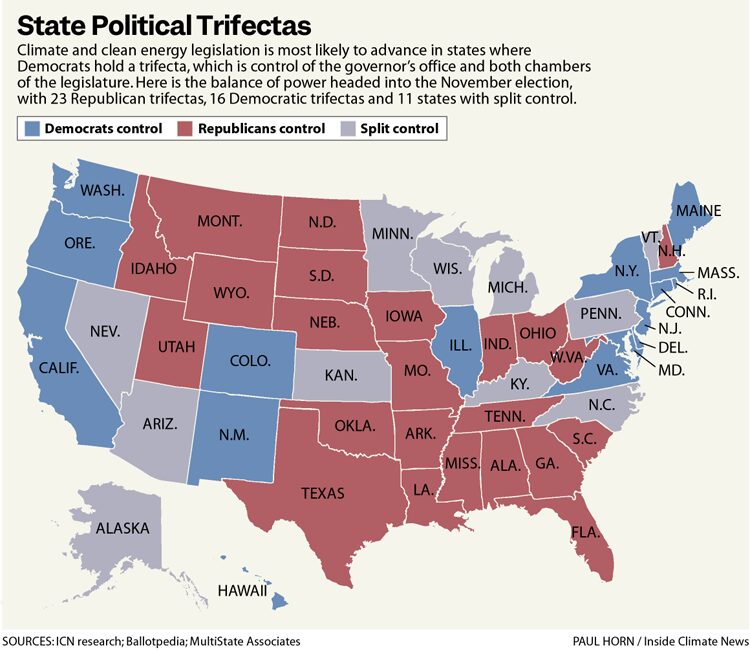
Inslee achieved that and many other climate policies largely because the Democratic Party had a trifecta in Washington from 2017 through the end of his tenure. There are currently 39 trifecta states — 16 controlled by Democrats, 23 controlled by Republicans. Democrats could achieve trifectas in at least Michigan, Minnesota, and Wisconsin, reports Dan Gearino of Inside Climate News, and Arizona, Nevada, and Pennsylvania could also be on the table. Those wins would increase the likelihood that addressing climate will be a policy priority.
The critical races in these states boil down to just a few seats, as gerrymandering and redistricting have locked in candidates at the local level, a “very similar dynamic to the House of Representatives,” Caroline Spears, the founder and executive director of Climate Cabinet, told Heatmap’s Robinson Meyer in a recent episode of the Shift Key podcast. Spears told Meyer she is watching just 22 seats among the more than 7,000 contests across the country that could shift control.
Climate advocates are hopeful that voters will give Democrats a trifecta in Wisconsin, Arizona and Pennsylvania for the first time in years, or in the case of Arizona and Pennsylvania decades, “giving them a first shot at climate policymaking,” writes Matthew Zeitlin for Heatmap.
Recommended Stories
Learn more about trifecta states, climate legislation, and the 2026 midterms with this great reporting.
- “These State Elections Could Reshape Climate and Energy Policy” By Dan Gearino for Inside Climate News (This piece is republishable for all outlets.)
- “Climate Races to Watch This November” By Matthew Zeitlin for Heatmap
- “The Weird State-Level Races That Matter for Climate Change” (audio + transcript) Heatmap’s Robinson Meyers talks to Caroline Spears on the Shiftkey podcast.
- “Michigan’s Energy Future: Affordability and Climate Resilience” (video) Virtual event by Grist and Interlochen Public Radio
- “With a Trifecta, Pennsylvania Democrats Would Pass Energy Reforms and Rein in Data Centers” By Ben Seal for Inside Climate News (This piece is republishable for all outlets.)
- “Voters, scientists say candidates should dig into environmental issues” By Ann Meyer for Green Bay Press Times
New Local Data Tool for Journalists

Early Voting Climate Voter Turnout
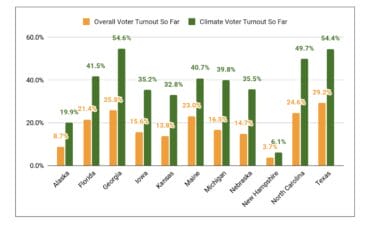
In our last newsletter, we wrote about the fact that millions of self-identifying “climate-first” registered voters didn’t vote in 2024. A new report from the Environmental Voter Project finds that more than 4.8 million climate voters in 21 states have already cast early ballots, including nearly 600,000 voting for the first time in a midterm election.
(Updated: Oct. 29)
CCNow Elections Guide
For the latest polls and studies connecting climate to local and national races, plus recordings of conversations with experts on energy affordability and voter concerns, and a curation of great stories making the climate-elections connection, check out our 2026 Elections Guide, which we’ll be updating through Election Day!
Before We Go…
Climate on the Ballot 2026 Reporting Initiative. We’d love to lift up the great coverage you’re doing about how climate factors into local, state, and congressional races. Send us your reporting to be featured in a curated selection of pieces. Email theresa[at]coveringclimatenow[
Know someone who might be interested in this newsletter? Forward Climate on the Ballot to a colleague!