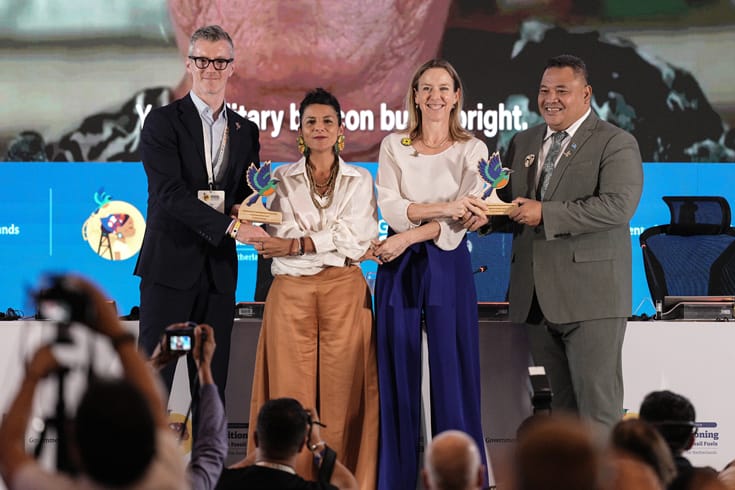
“You are the light in a tunnel of darkness,” climate scientist Johan Rockstrom told delegates at the First Conference On Transitioning Away From Fossil Fuels this week in Santa Marta, Colombia. After years of UN climate summits rarely even mentioning the words “fossil fuels,” 57 countries representing one-third of the world’s economy came to Santa Marta to discuss not whether, but how, to leave behind the primary driver of climate change. This potentially historic development drew strong media interest: 146 journalists from 61 news outlets and 28 countries attended in person, countless more followed the livestream, and abundant news coverage appeared around the world, according to the governments of Colombia and The Netherlands, the conference’s co-sponsors.
The gathering got an unexpected boost when the head of the International Energy Agency said in an interview with The Guardian that the war in Iran has broken fossil fuel markets beyond repair. The interruptions to oil and gas supplies and the resulting price spikes, said Turkish economist Fatih Birol, will forever turn countries away from fossil fuels and toward more secure renewable energy sources. “The damage is done,” added Birol, whose agency The New York Times has described as “enormously influential” on the long-term plans of energy companies and investors around the world.
Irene Vélez Torres, the environment minister of Colombia, welcomed Birol’s comments. “It seems that many of us are seeing at the same time that fossil fuels cannot provide energy security, because fossil fuels are subject to scarcity, and scarcity can be manipulated,” she said in an interview with Covering Climate Now.
The conference is separate from the UN process, so the goal was not to negotiate a legal agreement but to learn from everyone — including businesses, Indigenous peoples, and other parts of civil society — about the best ways to disentangle economies and societies from fossil fuels. Each country’s roadmap will be voluntary and specific to its own circumstances. “This conference is not about documents,” said Rachel Kyte, the UK special representative for climate. “It’s about finding fellow travelers and learning from them—what’s working, what isn’t?”
For example, France released what it called “the first national roadmap” by a developed country to phase out fossil fuels. The plan foresees removing coal from the national electricity grid by 2027, ending oil consumption by 2045 and gas by 2050. The Chinese electric car giant BYD and the Australian mining company Fortescue hosted a private sector roundtable aboard what Fortescue said was the world’s first cargo ship powered completely without fossil fuels. The company urged businesses and governments to pursue “real zero” emissions, rather than the “net zero” goal that employs carbon offsets and allows continued emissions. Asked about the 80–89% of people around the world who want stronger climate action, Ana Toni, the Brazilian diplomat who served as executive director of COP30 UN climate summit, urged citizens to act “at the national level. There are elections coming up, and what consumer choices people make also matter.”
The Santa Marta conference’s conclusions are aimed at accelerating progress at COP31 this coming November, but its larger impact may come from the economic heft of the conference’s “coalition of the willing.“ Joined in Santa Marta by California, the world’s fifth biggest economy, these countries account for 30% of global fossil fuel consumption. Withdrawing that buying power from oil, gas, and coal over the coming years could accelerate the retreat from fossil fuels foreseen by Birol.
Santa Marta may be a game-changing moment in the climate story, and journalists have an abundance of story lines to explore in the months ahead. Will the stirring rhetoric that governments expressed in Santa Marta be matched by policies they implement back home? Will more countries and subnational governments join their ranks? How will the big emitters that did not attend—the US, China, and other fossil fuel producing states and companies — react? A follow-up conference will take place in February 2027, hosted by the Pacific island nation of Tuvalu and co-sponsored by Ireland. “This is not the end,” Velez declared in the conference’s closing moments. “It is the beginning of a new global climate democracy.”
From Us
Free training! CCNow is accepting applications for the spring cohort of The Climate Newsroom, our three-session free training program for journalists in the US. Training begins the week of May 12. Learn more and apply by May 8.
CAAD-CCNow survey. Climate Action Against Disinformation (CAAD) and CCNow are developing a new, improved, and global “Journalist Field Guide to Covering Climate Disinformation,” building on CAAD’s existing resource. Read the current version and share your feedback by May 1, to help shape the new version.
Radar Clima: Cómo cubrir el Acuerdo de comercio entre la Unión Europea y Mercosur. La última edición de Radar Clima, nuestro boletín en español para periodistas de todas las áreas, te trae datos clave, recursos, contactos de voces expertas y ángulos de cobertura para reportear los ángulos climáticos de uno de los mayores acuerdos de libre comercio del mundo. Échale un vistazo a las ediciones anteriores y suscríbete para recibir el boletín los miércoles.
WATCH: Compelling Climate Visuals & Where to Find Them. Selecting the right visuals is crucial to accurately telling the climate story and engaging audiences. CCNow and Climate Visuals hosted a special webinar about how to visualize climate change with videos and stills. Watch now.
Noteworthy Stories
Age of electricity. Analysts say that the world is entering the “age of electricity” as consumers shift from fossil fuels to electricity for more and more everyday energy uses, such as driving cars, heating houses, and even some industrial operations, according to two new reports. By Zoya Teirstein for Grist…
- Learn how the US’s aging national grid is woefully inadequate for an electrified future. By Robinson Meyer for The New York Times…
Deforestation is down. In 2025, global tree loss fell by 14% from the year before, according to a new report from World Resources Institute. The decline was mostly due to better protections for rainforests, particularly in Brazil. But increasing wildfires offset those gains. By Sachi Kitajima Mulkey and Harry Stevens for The New York Times…
Climateflation. Making the connection between climate change impacts, like heatwaves, droughts, and floods, and cost of living expenses is complicated, but economists and central bankers are developing models to connect climate to grocery bills, housing costs, electricity bills, and more. By Emma Court for Bloomberg Green…
Russian workaround. California has the highest gas prices in the nation, averaging almost $6 a gallon. As gasoline reserves fell and prices spiked due to the Iran War, the state increased imports of Russian oil refined in a third country to stabilize supply, by relying on a “refining loophole.” By Aaron Cantú for Capital & Main…
On the Beat
Creator journalists. Liz Kelly Nelson, former legacy newsroom leader and founder of Project C, recently shared her thoughts on why younger audiences are turning to independent journalists and what it means for the greater news ecosystem in this Neiman Reports interview.
Quote of the Week
“Renewables offer something fossil fuels never did: stability and sovereignty. There are no embargoes, price shocks or tariffs. … Message for developed countries: Lead by example. Move first, fast, and furthest.”
– Selwin Hart, UN special adviser, speaking at the 1st Conference onTransitioning Away from Fossil Fuels
Resources & Events
Clean energy momentum. The Union of Concerned Scientists’ John Rogers, associate director of energy analytics, provides a comprehensive rundown of the latest reports and broken records from the renewable energy revolution.
RSVP: News Reimagined: The Creator Journalism Summit. During a one-day event at the National Press Club in Washington, D.C., on Monday, May 4, journalists, creators, and newsroom leaders will come together to discuss how to grow audiences and build trust. Learn more and RSVP.
Training: Featuring the Farm. Join Southlands Magazine founding editor and freelance writer Boyce Upholt on May 8 at 1pm US Eastern Time (5pm UTC) for a workshop about how to find, develop, and pitch feature stories on the food and ag beat. Learn more and RSVP.
Young people and the news. Join researchers from the Reuters Institute for a webinar on May 12 at 3pm SGT (7am UTC) to explore how 18- to 24-year-olds are engaging with news now, how their habits have evolved, and how journalists might better reach them. Learn more and RSVP.
Jobs, Etc.
Jobs. Lighthouse Reports is hiring a climate and environment editor (remote). Politico is looking for a deputy editor, energy & environment (Arlington, Va.). World Wildlife Fund seeks an Associate Specialist, Climate Communications (Washington, D.C.). Public First is looking for a Director of Media: Energy & Climate (London). The Raleigh News & Observer is looking for an Environmental Reporter (Raleigh, N.C.). McClatchy Media is hiring a California Meteorologist (Sacramento, Calf.). Climate Central is hiring a Vice President for Business Development (primarily remote).
Fellowships. Climate Tracker Asia is opening applications for the NextGen Climate Bootcamp 2026: Voices of Philippine Youth; apply by May 22. The Pulitzer Center is accepting applications for its Rainforest Investigations Network Fellowships; apply by May 22. The Chips Quinn Reporter Fellowship is accepting applications; apply between April 13 and May 13. Quanta Magazine is accepting applications from early-career science journalists for its summer/fall 2026 writing fellowship.
Freelance. ProPublica is accepting story pitches.