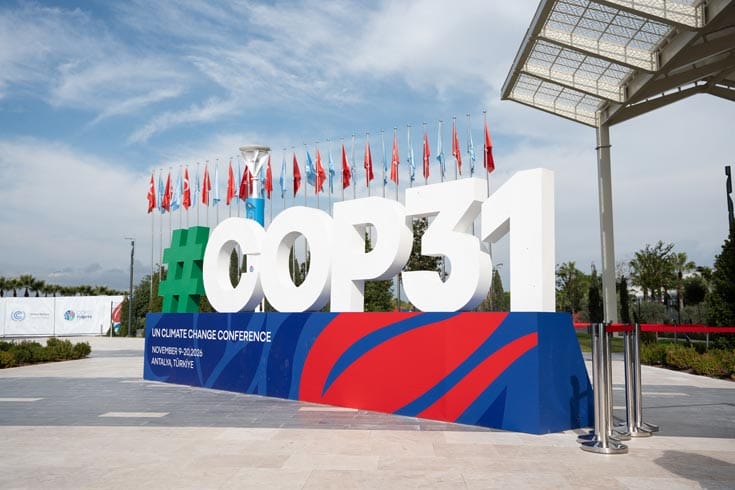
You may have heard that COP31 is a “low expectations” summit, but Covering Climate Now’s experience in Antalya has been anything but. Among our activities:
- We broke some important news, reporting in The Guardian that the leader of the world’s fourth biggest economy, California governor Gavin Newsom, explicitly endorsed the Santa Marta “coalition of the willing’s” global phaseout of the fossil fuels that drive climate breakdown. Newsom is expected to run for president in 2028; his statement raises the possibility that the US, the world’s biggest economy and largest historical emitter of planet-warming gases, could join the Santa Marta coalition if he wins. Mark Hertsgaard, CCNow’s executive director, wrote the story and discussed it on the TV and radio program Democracy Now.
- We organized a side event on CCNow’s 89 Percent Project with panelists from the oak milk company Oatly and the NGOs Media Is Hope and Talking Climate Collaborative, each of which has been spreading the 89% message: The overwhelming majority of the world’s people — eight out of 10 — want their governments to take stronger climate action, but these same people don’t realize they are an overwhelming majority. The side event was held at the Ukraine pavilion, which is a remarkable climate story in its own right: In the middle of an ongoing war, the country has installed three gigawatts of renewable energy since 2022.
- In an explainer video, we took on the mistaken but widely held belief that decisions at COPs require consensus among participating governments, a belief long exploited by petrostates to stall progress. In fact, there was “a huge debate” at the first COP, in 1995, about whether to make decisions by consensus or majority rule, but no agreement was reached, Johan Rockström, the director of the Potsdam Institute for Climate Impacts Research, said at a CCNow Press Briefing. Nevertheless, over the years, “a culture took hold … to operate under consensus,” Rockström added, but the truth is that “there is nothing hindering… the COP process to have majority voting.”
- We connected with scores of journalists from around the world, posting interviews with colleagues from Indonesia, Venezuela, the UK, Argentina, Nigeria, host country Turkey, and others describing the stories they are reporting at COP31, including the Turkish government’s blatant attacks on independent media.
- We saved time for fun as well, hosting two well-attended journalists-only happy hours that strengthened the sense of community among climate journalists. Media Is Hope used the occasion to present Hertsgaard with its Hall of Fame award.
“Our first climate duty is to tell the truth,” UN Secretary-General António Guterres said in his speech to the COP31 Leaders Summit. CCNow has long said that telling the truth about the depth of the climate crisis and the abundance of practical solutions is itself an essential climate solution. Covering COP31 has reminded us how privileged we are to do this work with so many colleagues around the world.
From Us
Watch: How to Cover Heat Impacts on Health in West Africa During an El Niño. Dig into how the current El Niño will push temperatures beyond normal, impacting the Sahel and West Africa. Panelists included Mariam Ileyemi of Nigeria’s Premium Times (Nigeria), Genevieve Maricle, of the the University of Chicago’s Energy Policy Institute, and Albert Oppong-Ansah, of the Ghana News Agency; Kizito Cudjoe of the Business & Financial Times (Ghana) moderated.
RSVP: CCNow Basics: Climate Science 101. Join us on Thursday, December 3, at 9am US Eastern Time (14h UTC), for a Climate Science 101 training session specifically designed for journalists. Whether you’re completely new to climate reporting or a seasoned editor who needs a refresher and a simpler way to explain the science to your team, this session is for you.
Noteworthy Stories
“Ghost” summit. COP31 is threatening to be a failure, according to campaigners. All reference to “fossil fuels” has been stripped from the draft agreement, which also fails to show how developing nations will receive financial support to adapt to climate change. “While we listen to endless oratory, the planet is being destroyed,” said Panama’s environment minister, Juan Carlos Navarro. By Fiona Harvey, Graham Readfearn, Damien Gayle, Gabrielle Canon, and Oliver Milman for The Guardian…
Data centers energy spike. By 2030, data centers will use twice as much electricity as they do today, the International Energy Agency has warned. AI is expected to account for three-quarters of that increase, with the US and China both overwhelmingly turning to fossil fuels to power the AI boom. By Jillian Ambrose for The Guardian…
Fiji state of disaster. The government of Fiji has declared a state of disaster, as an El Niño–fueled drought has prompted widespread water shortages across the country. Fiji’s weather service forecasts below-average rainfall through April 2027. From Reuters…
CO2 exporters. Russia, Saudi Arabia, and Australia are history’s largest exporters of carbon dioxide, according to new analysis by Carbon Brief. When factoring in its fossil fuel exports, Saudi Arabia becomes responsible for four times as much global heating than the estimates usually attributed to the country. By Simon Evans for Carbon Brief…
Quote of the Week
“The fact of the matter is most people deeply care about [climate change]. Not as an abstract issue about other people in other parts of the world, but because climate change is affecting everyone somehow, some way.”
– Amy Goodman, at COP31, on journalists’ responsibility to cover climate change
Resources & Events
- Track COP31: “Interactive: Tracking Negotiating Texts at the COP31 Climate Summit” (Carbon Brief)
- Subscribe: Climate Diplomacy Brief offers expert insights on COP31 and global climate diplomacy. Read the latest, “COP31 day 10.”
- New analysis: “Winter Warming Driven by Climate Change (1970-2026)” (Climate Central)
- RSVP: “Generative AI and News Report 2026: From Standalone Tools to Information Infrastructure” on Tuesday, November 24, at 11am US Eastern Time (4pm UTC)
- RSVP: “Is the Future of Jobs Threatened by Heat and Climate Change?” on Wednesday, November 25, at 4pm West Africa Time (3pm UTC)
Jobs, Etc.
Jobs. Scientific American is hiring a Senior Enterprise Editor (remote). Grist is hiring a Social Audience Producer (remote). SEJournal is hiring a Social Media News Editor and a TipSheet Writer (remote, part time). The Guardian is hiring an Editor for its Seascape global reporting project (London). Semafor is hiring a Flagship Lead Editor (London). Alaska Public Media is hiring a Chief Editor & Vice President of Journalism (Anchorage, Alaska). The New York Climate Exchange is hiring a Digital Storytelling Lead (New York, N.Y.). The Wall Street Journal is hiring a South Asia Correspondent (New Delhi, India). Inside Climate News is hiring a Senior Editor (remote, American West preferred). WIRED is hiring a Features Editor (New York, N.Y.). The Audubon Society is hiring a Senior Writer, Executive Communications (Washington, D.C.), and an Editorial Fellow (New York, N.Y.).
Fellowships, Tours, Grants & Pitch Opportunities.
- Informed Earth has several opportunities for journalists in South Asia, Africa, the Western Balkans, as well as a three-day virtual workshop on covering fisheries transparency open to all journalists.
- Investigative Reporters & Editors is accepting applications for its Data Journalism Bootcamp scheduled for January 11–15, 2027 in Columbia, Mo.; apply by December 6.

This week, we’re highlighting winners from the Business & Economics and Conflict categories. The Business category was for work that helps audiences parse truth from falsehood — work that debunks denial and delay, greenwashing, conspiracy theories, and more, while calling out the powerful interests responsible and the means by which disinformation spreads. The Conflict category was for work shining a light on the intersections of climate change and violent conflict, including militaries’ carbon footprints, wartime damage to ecosystems, and the potential of climate change to fuel future conflict by driving instability.
The Strange and Totally Real Plan to Blot Out the Sun and Reverse Global Warming
By Karl Mathiesen & Corbin Hiar with Laurens Cerulus, Reto Albertalli, Amit Elkayam & Nicolás Ortega
Politico
From Asbestos to Rare Earths, Brazilian City Lives Between the Past and Future of Mining
By Isabel Seta
Agência Pública (Brazil)
Check out the citations for these winners and find links to their stories here.
Climate and War
By Mohammed Sawwaf & Shrouq Aila, with Salah Al Haw, Mohammed Mortaja, Ahmad Abu Ajwa, Ibrahim Al Otla, Iktimal Al Aila, Hedaa Al Dahdouh, Ahmad Al Shiyah & Mahmoud Al Sarraj
Arab Reporters for Investigative Journalism (Jordan)
Check out the citations for these winners and find links to their stories here.