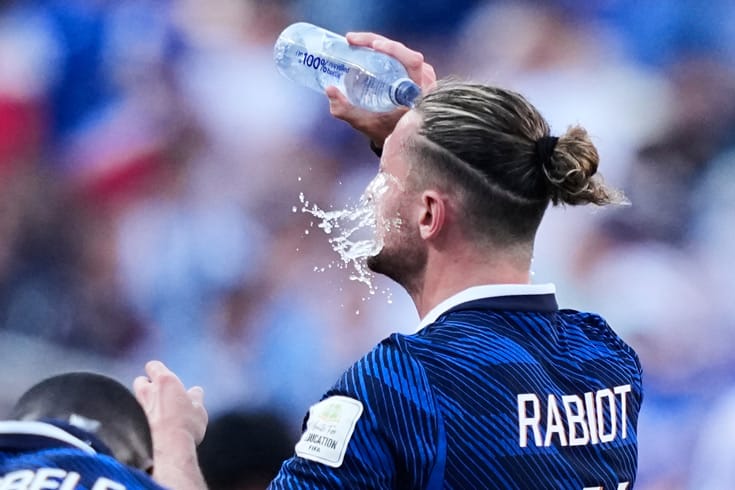
The 2026 World Cup will be remembered in part for bringing the term “hydration break” into the global football lexicon. For the first time in the Cup’s 96-year history, matches were interrupted midway through each half so players could hydrate and rest. Many fans disliked the breaks, complaining they were simply an excuse to show more TV commercials during what is, after all, the most watched sporting event on Earth.
That suspicion is not entirely wrong, but it confuses outcome with cause. There are good reasons, grounded in science and articulated by the international football players union, for hydration breaks. But almost none of the US media coverage of the 2026 World Cup, with one outstanding exception, highlighted those reasons, much less explained them.
The exception was Telemundo, the Spanish language TV network whose news division has been a leader in climate coverage. On July 3, journalist Vanessa Hauc, the host of Telemundo’s weekly environment program “Planeta Tierra,” appeared on the broadcast of the much-anticipated match between the defending champions, Argentina, and everyone’s favorite underdogs, Cape Verde. At the time, hundreds of millions of Americans were under extreme heat warnings from a “heat dome” that scientists said would have been “virtually impossible” without climate change.
Andrés Cantor, the Telemundo announcer famous for his prolonged shout of “Gooooooooal” whenever a team scores, introduced Hauc, saying that “although the hydration breaks are highly controversial, there’s a deeper reason for them.” Hauc reported that the game-time temperature of 89 degrees Fahrenheit in Miami “can feel closer to 101 [degrees F]” on the field, when humidity and the sun’s rays are factored in. “That’s why hydration breaks aren’t just a precaution, they’re a safety measure in an increasingly hotter world,” she said, adding that the world is hotter mainly because of “the way we produce energy, primarily by burning oil, coal, and natural gas.”
That evening, Colombia faced Ghana in Kansas City, where the weather was equally oppressive: 88 degrees F with 70% humidity. Hauc reported that such conditions “make it harder for the body to cool itself, causing core body temperature to rise and increasing the risk of exhaustion, dehydration, and even heat stroke” for the players. She added, “Behind all of this is a larger reality: heatwaves are becoming more frequent, more intense, and longer lasting because of the climate crisis, driven primarily by the burning of fossil fuels.”
In interventions of only 42 and 52 seconds, respectively, Hauc delivered a master class in climate reporting. She humanized the story by talking about the scorching heat that players and viewers were experiencing. She localized the story, in emotional terms, by describing the impacts on the sport so many people love. And she “solution-ized” the story by naming the cause of the problem — the burning of oil, gas, and coal — and advising that, “As the planet continues to warm, the game of soccer and sports more broadly will have to adapt.”
FIFPRO, the players union, began making that argument well before the 2026 World Cup, spurred by the increasingly harsh playing conditions its members had been facing. The heat and humidity were so brutal at last summer’s FIFA Club World Cup tournament that one referee fainted on the field. Enzo Fernando, the Argentinian whose Chelsea club won that tournament (which was played in the same stadium in New Jersey that hosted the 2026 World Cup final where Fernando’s national team lost to Spain), said at the time, “I had to lie down on the ground because I was really dizzy. Playing in this temperature is very dangerous.”
FIFPRO commissioned a scientific study examining what such temperatures meant for players’ health and performance, and it shared the study’s results with FIFA. The union recommended introducing breaks in play if the “wet bulb global temperature” — which combines temperature and humidity levels — reached 26 degrees Celsius (roughly 79 degrees F) and suspending play at 28 degrees C (roughly 82 degrees F). FIFA disagreed, wanting cooling breaks only at 32 degrees C (roughly 90 F). The compromise appears to have been adding hydration breaks during the 2026 World Cup.
This explanation by no means quiets suspicions about FIFA’s appetite for additional TV money. FIFA head Gianni Infantino denied such accusations, saying that hydration breaks resulted in “no additional revenue for FIFA, as all commercial agreements were signed well in advance.” That is technically correct but utterly incomplete: The six extra minutes of TV commercials made possible by hydration breaks clearly increase the value of the TV contracts FIFA can sell for World Cups in 2030 and beyond.
To be clear, Telemundo was not above making extra money from hydration breaks; ads wrapped around the left and bottom edges of the screen while Hauc or her sports colleagues offered their commentary. But Telemundo, meanwhile, made sure to help its viewers understand why these hydration breaks were happening in the first place.
That was both journalistically responsible and commercially shrewd. A study released last month by the Yale Program on Climate Change Communication found that 74% of Americans, roughly three out of four, say “they are interested in news stories about global warming.” Other polling has documented that Latinos have long been even more concerned about climate change than the general population.
Hauc and Telemundo’s example shows what the rest of the media could have done to help audiences understand why the 2026 World Cup was played differently than any other — and why football is not the only sport changing its procedures in the face of global warming. As Hauc reported, the governing body of professional tennis now allows players to request a cooling break when the wet bulb global temperature exceeds 30 degrees C (roughly 86 degrees F). The Los Angeles Marathon this year allowed runners to officially finish the race at mile 18 instead of mile 26 due to extreme heat.
And these measures are only the beginning, for the physics is unequivocal: Global temperatures will continue to climb until the burning of fossil fuels is phased out. And the longer we wait, the greater the paradox confronting us: As hot as the summer of 2026 is, it will be remembered as one of the cooler summers of our lives.
From Us
RSVP! Wildfires and Climate: Experts Help You Get the Story Right. Join Covering Climate Now and Climate-Colored Goggles TODAY at 12pm ET for a special conversation moderated by Sammy Roth about wildfires, the climate connection, and how the press can get this story right.
RSVP! Climate Blueprint: Don’t Underestimate the Impact of Climate Stories. Join CCNow and Solutions Journalism Network on Tuesday, August 4, at 12pm US Eastern Time (4pm UTC) for a special conversation about impact tracking in journalism, based off the collaborative Climate Blueprint project.
Apply: The Covering Climate Now Academy. We’re now accepting applications for our free three-month training program that runs from September to December 2026. With 40 slots available, become part of a global community and learn climate science basics, how to practice solutions journalism, how to debunk disinformation, and much more. Deadline: Tuesday, August 11.
RSVP! CCNow Basics: Three Pillars. Join us on Wednesday, August 12, at 10am US Eastern Time (2pm UTC), for a training session on CCNow’s Three Pillars approach to covering climate change: humanize, localize, solution-ize. All journalists, especially early-career reporters, are invited!
Radar Clima: Biocombustibles para principiantes. La última edición de Radar Clima, nuestro boletín en español para periodistas de todas las áreas, te da las claves para cubrir los biocombustibles con rigor: qué son, sus tres generaciones, por qué su balance climático depende del uso del suelo y los fertilizantes, y cómo se producen y comercian en toda la región. Échale un vistazo a las ediciones anteriores y suscríbete para recibir el boletín los miércoles.
El Niño en Centroamérica Panel. CCNow, Periodistas por el Planeta y el Colegio de Periodistas y Profesionales de la Comunicación de Costa Rica (COLPER) invitan a todos y todas las periodistas a un panel informativo sobre cómo comunicar El Niño en Centroamérica. El panel tendrá lugar en vivo en San José, Costa Rica, el próximo martes 28 de julio a las 9:30 h. Más información aquí. Pueden reservar espacio de forma gratuita en este formulario y seguir la transmisión del evento en vivo desde cualquier lugar de la región a través de este enlace.
Noteworthy Stories
Suing Big Oil. A first-of-its-kind lawsuit is moving forward to the discovery and trial stage in Washington state. Misti Leon is suing oil and gas companies for the wrongful death of her mother during the 2021 Pacific Northwest heat dome that killed more than 1,400 people. “This is a big deal,” writes Aaron Regunberg for The New Republic…
Climate impacts. Americans are making the connection between climate change and this summer’s droughts, floods, extreme heat, wildfires, and toxic smoke. Majorities of likely voters say extreme weather events are being “worsened by climate change” and 61% say that extreme weather is increasing, according to a new Data for Progress survey. By Dharna Noor for The Guardian…
PR lies. A new report details how oil and gas companies knew that methane emissions caused climate change in the 1970s, but opted to launch a PR campaign that touted “natural” gas as clean energy. By Sarah Hofmann for Desmog… (Note: This story is republishable for partners, via our Sharing Library.)
Dramatic evacuation. Unexpected, high velocity wildfires in Northern Ontario, Canada, destroyed the Namaygoosisagagun (Collins) First Nation. Many residents had only minutes to grab belongings and board boats to safety. By Miles Morrisseau for ICT… (Note: This story is also republishable, via our Sharing Library.)
Red card for climate. The last time the Spanish men’s team won the World Cup was 2010. Data, extreme weather, and other impacts over those 16 years show how quickly and profoundly the climate crisis is altering not only Spain, but the entire planet. By Eduardo Robaina for Climática…
Quote of the Week
“We are given only a limited number of truly perfect summer days in our time on Earth. One of the more insidious cruelties of fossil fuel greed is how it slowly strips those days from us, more and more throughout our lifetimes, perhaps without us even realizing what we have lost.”
– Heated’s Emily Atkin, “Another stolen summer day: What are we still waiting to learn?”
Missed Connections
The Washington Post continues to not mention climate change in its weather coverage, as Philip Eubanks, executive director of the Climate Emergency Fund, noted in a LinkedIn post directed at the reporter and editor of an otherwise detailed article on the Canadian wildfire smoke experienced by as many as 115 million people in the northern US last weekend.
Resources & Events
- “Climate Frontline Toolkit: Printable Field Guides to help journalists prepare for climate hazards” (European Journalism Centre and REVOLVE)
- “The Fraud of ‘Clean’ Natural Gas: How Big Oil and Gas Created the Myth that Natural Gas is a Climate Solution” (Center for Climate Integrity)
- “Attribution of Extreme Weather and Climate Events and Their Impacts” (National Academies Press)
- “A Majority of [US] Voters Support Worker Protections Against Extreme Heat” (Data for Progress)
- Training: “Reporting from the Margins” is a free, four-session journalism course offered in English by Unfiltered, a small, journalist-owned cooperative, focusing on covering marginalized communities in Japan, is offering a free, four session journalism course
- RSVP: “Can This Climate Policy Actually Work? Learn How to Test It with En-ROADS,” hosted by Climate Tracker Asia and Climate Interactive, on Tuesday, July 28, at 9am Jakarta time, and Thursday, July 30, at 5pm IST
Jobs, Etc.
Jobs. Climate Central is hiring a Chief Communications Officer (remote). The Santa Barbara News-Press is hiring a Climate, Environment & Water Reporter (Santa Barbara, Calif.). The Texas Tribune is hiring an Immigration, Environment, and Climate Editor (remote in Texas). CalMatters and Grist are hiring a Climate Reporter (remote, Central Valley, Calif.). Mongabay is hiring a Managing Editor – Africa (English), an Associate Editor – Story Transformer, and a Senior Video Story Editor (all remote). The University of Chicago Institute for Climate and Sustainable Growth is hiring a Communications Specialist, Science and Technology (Chicago, Ill.). NPR’s Science Friday is hiring an Associate Producer, Audio (remote or NYC). ProPublica is hiring a California Reporter (remote, California). The Times-Picayune/The Advocate is hiring an Environmental Reporter (New Orleans, La.).
Fellowships & Grants. The Metcalf Institute is accepting applications from New England journalists for its Climate Ready Newsrooms Fellowship for Local Journalism; apply by July 31, 2026. Climate Tracker and Oxfam are offering five $500 reporting grants for stories about women and just transition in Latin America for journalists from Guatemala, Honduras, El Salvador, Mexico, Colombia, Peru, Bolivia, and Brazil; apply by August 2, 2026.
Freelance. Dialogue Earth is accepting pitches for photo and social-first stories on heat solutions in the Global South.