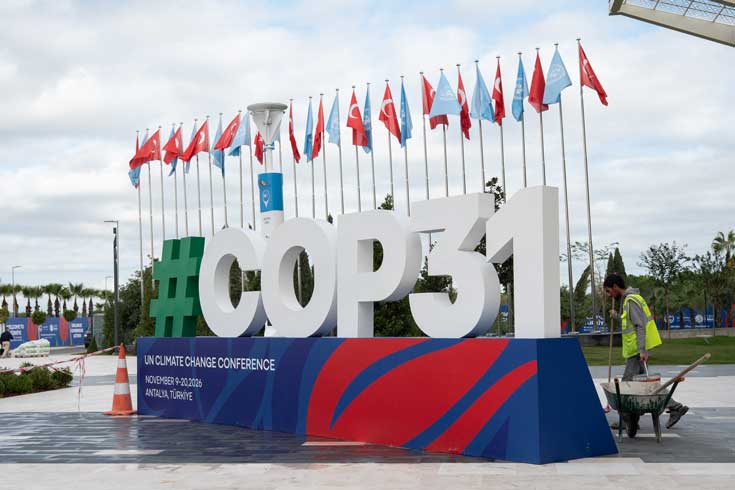
The unprecedented rebuke of US president Donald Trump in the midterm elections opens the door to a new era in climate policy at home and abroad. This issue of The Climate Beat offers our fellow journalists background knowledge and practical tips for covering the next episode of this new era: the COP31 UN climate summit in Antalya, Turkey, that begins next Monday, November 9, and continues through November 20.
CCNow will be on the ground at COP31. If you are going to be there, please let us know so we connect using this form. Check out our side event on The 89 Percent Project, featuring the oat drink company Oatly and the Japanese NGO Media Is Hope, at 11am local time on November 12 in the Ukraine pavilion; the event will also be live-streamed. Also look for us in the media hall, and drop by our happy hours on November 16 and November 18 from 6 to 8pm at Karaf Bistro in Antalya’s old town district.
Domestically, the US election results mean that Trump will no longer have a rubber-stamping Congress. Elected Democrats will have multiple tools for “a [new] level of oversight,” Bloomberg reports; they may not be able to advance their own climate agenda — as president, Trump can veto — but they can block Trump’s agenda, mainly because Congress controls the federal budget. Trump can still use executive orders for limited purposes, but Congress could remove the funding needed to carry out such orders, and the next president could simply cancel them.
Internationally, the US elections will make COP31 a much more interesting news story. UN climate summits have become synonymous with low expectations: long on rhetoric, short on action. But with Trump’s aura of invincibility shattered, other countries can look ahead to a time when the climate policies of the world’s biggest economy and historical emitter might be different. How will China, the EU, and other powers respond? With August’s deadly glacier collapse in Nepal fresh in people’s minds, will climate vulnerable countries gain momentum on “loss and damage” and other forms of aid?
Perhaps the most interesting story at COP31 is one the press is only beginning to recognize. At COP30, more than 80 countries wanted to develop a global roadmap to phase out fossil fuels, but a handful of petrostates blocked them. In April, 57 of those countries met in Santa Marta, Colombia, to begin drawing up a roadmap anyway. What makes that Santa Marta “coalition of the willing” worth watching is that those countries collectively amount to the world’s biggest economic superpower. If enough of them withdraw their buying power from fossil fuels, it would send an unmistakable signal to governments and financial markets around the world that staying invested in fossil fuels could become a money-losing proposition.
Journalists should bear in mind that COP31 is taking place in a country with a record of repressing independent voices of civil society, including the press. Most recently, authorities raided the offices of Halk TV on October 14 and replaced its leader with a government-appointed administrator. Human Rights Watch has charged that the government of President Recep Tayyip Erdoğan has “arrested and prosecuted environmental defenders [and] prevented journalists from filming protests.”
It’s too late now to apply for press credentials to cover COP31 in person, but covering it remotely has never been easier, because many sessions will be live streamed. The key to doing good remote coverage, according to Doreen Ajiambo, whose reporting on what COP30 could mean for women in the Horn of Africa won a CCNow Journalism Award, is “to find real people who have been affected by climate change…. Then you bring in what is being said at COP, what commitments are being made by world leaders.”
Every reporter covering COP31, whether on site or remotely, will benefit from a few essential resources:
- The UN Framework Convention on Climate Change (UNFCCC) COP31 landing page contains links to the summit schedule, agenda documents, and media resources, including press releases from governments and civil society groups.
- The Earth Negotiations Bulletin (available in English, French, and Spanish) provides an authoritative summary of the previous day’s developments along with a list of what’s on tap today.
- For a similar service from an activist perspective, see the daily updates from the Climate Action Network, including a sample from COP30.
- Follow the coverage by The Guardian, Agence France-Presse, and other news organizations that prioritize the climate story. (AFP, for example, will have 17 journalists in Antalya.)
Preparing in advance makes a huge difference to the coverage you produce. CCNow organized four webinars last week to help journalists get ready for COP31; our panelists had covered many previous COPs, and virtually every one of them emphasized that COPs are so full of activity that it’s easy to get overwhelmed. For best results, they advised, decide in advance which topics you want to cover and then stick with them.
Targeted background reading is essential. Check out CCNow’s COP31 resources, including videos of our COP31 webinars and of a CCNow press briefing featuring leading experts on how COPs work and what to expect in Antalya. To understand how strong the climate policies and records of countries are, check the Climate Action Tracker published by Climate Analytics, which draws on a plethora of data to rank countries on a scale from “Critically Insufficient” to “Insufficient” to “1.5C Paris Agreement Compatible.” Carbon Brief’s “Who Wants What” database shows how each country in the world stands on key issues at COP31.
Once the summit is underway, heed a caution voiced by the experts at CCNow’s press briefing: COPs are becoming less a forum for negotiating a final agreement — partly because petrostates don’t want action — and more a forum where like-minded countries share plans and learn from one another about implementing stronger policies.
The Santa Marta coalition is an outstanding example, and on November 16, it will release a report on its progress to date, according to Stientje van Veldhoven, The Netherlands’ climate minister and Santa Marta co-chair. Germany, France, and The Netherlands have already published plans to phase out fossil fuels; on November 16, additional countries will announce commitments, van Veldhoven confirmed. That said, journalists who want to follow COP31’s formal negotiations can see how the text is evolving via Carbon Brief’s “text tracker.” (Check out the COP30 text tracker.)
Last but not least: Covering a COP is a marathon, not a sprint. Make sure to eat well, sleep properly, and stay hydrated. COPs invariably extend into the wee hours of the last day or beyond. To understand those final hours — and convey their significance to your audience — you’ll want to be physically and mentally fresh.
From Us
CCNow in Turkey. Join us at COP31 for a panel conversation, “The Ultimate Climate Solution: The Power of the 89% Global Majority, ” in Ukraine’s pavilion, inside the Blue Zone, on Thursday, November 12, at 11am local time.
Watch: Prep Yourself to Cover COP31. Whether you’re reporting on COP31 from Turkey or remotely, we have you covered with these geographically targeted prep sessions to get you ready to deliver great coverage to your audiences.
Quote of the Week
“Climate voters turned out in record numbers for these midterm elections, blowing away turnout rates from 2022 and even 2024. These results aren’t just good news for the climate, they’re a sign we’ve all been waiting for that the climate movement is starting to wield real political power.”
– Nathaniel Stinnett, Founder and Executive Director of the Environmental Voter Project, said in a statement
Noteworthy Stories
‘Documents of implementation.’ On Tuesday, COP30 host Brazil published the first global roadmap for phasing out fossil fuels in the hopes of pushing countries at COP31 to move from negotiating agreements to implementing targets agreed upon in the Paris Agreement. By Fiona Harvey for The Guardian…
- Brazil also released a roadmap for ending deforestation that nearly 100 countries supported at COP30. Aruna Chandrasekhar and Dr Giuliana Viglione break it down in a Q&A for Carbon Brief…
COP31 priorities tracker. This interactive details countries’ and UN negotiating blocs’ positions on key topics and other issues that will be debated at COP31. Bookmark it and check back for updates throughout the summit. By Josh Gabbatiss and Molly Lempriere for Carbon Brief…
- The world can’t rely on markets alone to ensure the success of the energy transition, argues COP31 President Murat Kurum. Governments must do their part, he writes in The Economist…
Blue wave. Democrats flipped control of the US Congress in Tuesday’s election, winning key races that could impact the future of climate action in Washington and locally. From Grist…
- How could the 120th Congress impact climate policy? Expect investigations of Trump officials, discussions about appropriations for scientific research, and debates about the Bipartisan American Affordability and Jobs Act (BAAJA), writes Zahra Hirji for Bloomberg Green.
Heat and pregnancy. A growing body of medical research finds that heatwaves are dangerous to the health of pregnant women and their babies, increasing the risk of myriad complications, including miscarriage, birth defects, and preterm births. By Pete McKenzie, Laura Gottesdiener, and Maurice Tamman for Reuters…
Secret vote. Under pressure from Saudi Arabia and other oil-producing nations, in 2005, the UN brought together 100 scientists to finalize a report about the future potential of carbon capture and storage. Despite little scientific evidence, the report projected that 99% of CO2 emissions captured could be buried underground, legitimizing a costly climate solution that has not panned out. By Katie Worth for ProPublica (additional reporting by Amy Westervelt and Maddie Stone of Drilled)…
Resources & Events
- “‘Averting global meltdown’ – Scientists show catastrophic ice impacts of overshooting 1.5°C and need for urgent emissions cuts to recover” (Ice Blog)
- “Increase of tropical cyclone-induced coastal flooding due to historical sea level rise” (IOP Science)
- “Potential impacts of the Bipartisan American Affordability and Jobs Act on United States energy systems” (Dr. Kevin J. Kircher, Assistant Professor, Purdue University)
- “The Value of Electric Power Transmission in a New Energy Context” (Rhodium Group)
- “The Impact of El Niño on the US Economy” (Federal Reserve Bank of San Francisco)
- “Evaluating the effectiveness of climate change communication to young people across Southern Africa” (Frontiers in Climate)
- “India’s emissions growth slows as renewable energy begins replacing coal, UNEP report finds” (Manish Chandra Mishra, Mongabay)
- “Attribution science and climate change litigation in India” (Springer Nature)
- “North India getting hotter, drier, South wetter: A study of 70-year climate trends uncovers worrying climate shift” (Gerard de Souza, Hindustan Times)
- RSVP: The Monthly Climate Brief, hosted by Climate Central on Tuesday, November 17, at 12pm US Eastern Time
Jobs, Etc.
Jobs. The Guardian is hiring an Editor for its Seascape global reporting project (London). Semafor is hiring a Flagship Lead Editor (London). Alaska Public Media is hiring a Chief Editor & Vice President of Journalism (Anchorage, Alaska). The New York Climate Exchange is hiring a Digital Storytelling Lead (New York, N.Y.). The Wall Street Journal is hiring a South Asia Correspondent (New Delhi, India). Inside Climate News is hiring a Senior Editor (remote, American West preferred). WIRED is hiring a Features Editor (New York, N.Y.). SciLine is hiring an On-Call Reporter (remote). The Audubon Society is hiring a Senior Writer, Executive Communications (Washington, D.C.) and an Editorial Fellow (New York, N.Y.). Bloomberg Industry Group is hiring a News Team Lead – Environment (Arlington, Va.). Bloomberg News is hiring an Africa Broadcast Producer (Johannesburg, South Africa). Heatmap is hiring a Senior Editor (remote). Columbia University’s Graduate School of Journalism is hiring a David Laventhol Visiting Professor (New York, N.Y.). The Council on Foreign Relations is hiring a Research Associate, Energy and Climate (New York, N.Y.). POLITICO is hiring an Energy and Climate Reporter (Brussels, Belgium). ON PURPOSE is hiring a Senior Content Writer (Delhi, India).
Fellowships, Tours, Grants & Pitch Opportunities.
- Informed Earth has several opportunities for journalists in South Asia, Africa, the Western Balkans, and a three-day virtual workshop on covering fisheries transparency open to all journalists.
- The National Institute for Computer-Assisted Reporting is accepting applications for the Philip Meyer Journalism Award, which rewards outstanding work using social science research methods; apply by November 18.
- The New York Times is accepting applications for the Times Fellowship, its yearlong opportunity for early career journalists; apply by November 20.
- Investigative Reporters & Editors is accepting applications for its Data Journalism Bootcamp scheduled for January 11–15, 2027 in Columbia, Mo.; apply by December 6.
CCNow Journalism Awards
Over the coming months, in each edition of this newsletter, we’ll be spotlighting one category from the 2026 Covering Climate Now Journalism Awards. See all the winning work and help us celebrate the winners here.

This week, we’re highlighting winners from the Disinformation category. Despite wider awareness than ever of the climate crisis, disinformation thrived in 2025. This category was for work that helps audiences parse truth from falsehood — work that debunks denial and delay, greenwashing, conspiracy theories, and more, while calling out the powerful interests responsible and the means by which disinformation spreads.
Carbon Bros
Daniel Penny & Amy Westervelt with Martin Austwick
Drilled & Non-Toxic
The Man Behind the Fall of Offshore Wind
Clare Fieseler with Greg Kahn
Canary Media
How Brazil’s Oil Giant Is Using Gen-Z Science and Climate Influencers to Green up Its Image
Juliana Aguilera
Agência Pública (Brazil) & Desmog
Check out the citations for these winners and find links to their stories here.