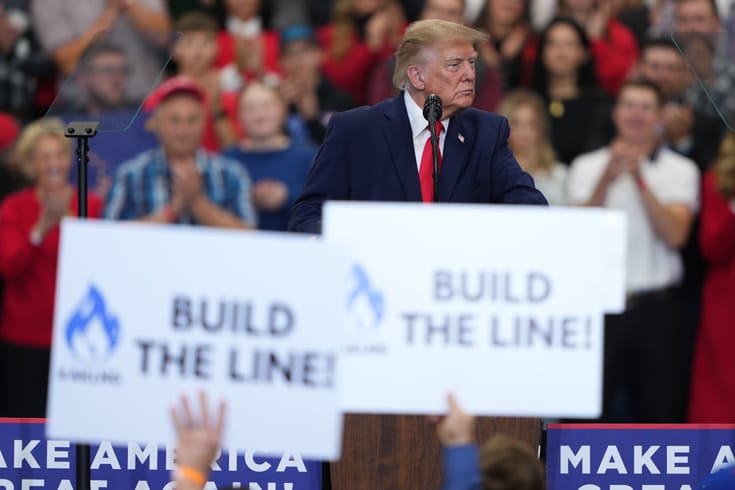
With the US midterm elections less than three weeks away, is it any surprise that corruption has emerged as voters’ top concern? “Corrupt” was the adjective most often chosen when registered voters were asked for a single word to describe President Donald Trump, according to a survey conducted in September by The Economist and the market research firm YouGov, with 53% of respondents calling Trump corrupt and only 23% saying he is “honest.” A Pew Research Center poll in early October found that nearly seven in 10 (69%) of Americans are “not confident” that Trump keeps his business interests separate from his presidential decisions.
Americans can thank diligent investigative reporting for alerting them to much of the self-dealing by Trump, his family, and aides. For example, The Washington Post has reported that Trump’s sons, Don Jr. and Eric, were investors in 15 companies that “collectively generated at least $3.2 billion in direct government business since the sons invested and an additional $3.1 billion in future contract options.” On Tuesday, in a rare retreat, the White House asked Kimberly Guilfoyle to resign as US ambassador to Greece after a Wall Street Journal investigation revealed that Guilfoyle promised political favors to a Trump donor if he would quietly pay off her $100,000 American Express credit card bill.
Throughout the history of modern polling, voters have usually ranked the economy (or its proxies, such as “the cost of living”) as their top issue. Now, linking corruption with the cost of living, “Democrats Are Making Corruption Messaging a Pocketbook Issue,” a recent Politico headline declared. The Democrats’ claim, The New York Times reported, “is that rampant corruption in Congress and the administration is directly costing average citizens who are paying more for necessities like groceries, gas, and medicine….”
Both Democrats and the press, however, so far, are overlooking one of the most overt and consequential examples of Trump’s pay-to-play behavior. On May 24, 2024, Josh Dawsey and Maxine Joselow of The Washington Post published a blockbuster expose, reporting that Trump privately told a group of oil company CEOs they should donate $1 billion to his 2024 presidential campaign. It would be a good “deal” for the industry, Trump reportedly said, because of the tax and regulation benefits they would receive if he returned to the Oval Office.
Specifically, Trump reportedly said he would reverse the Biden administration’s pause on new liquified natural gas (LNG) export permits, approve more drilling for oil in the Gulf of Mexico and Alaska, and roll back environmental regulations the industry didn’t like, including electric vehicle purchasing mandates and vehicle emissions limits. Dawsey and Joselow then published a follow-up, reporting that Trump also promised to soften Federal Trade Commission scrutiny of industry mergers and acquisitions.
Two and a half years later, his administration has delivered on each of these promises and then some. The Brennan Center has published a well-documented summary of Trump’s assault on climate policy — including his administration’s repeal of the “endangerment finding” that has granted the federal government the authority to regulate greenhouse gas emissions — that connects the dots between Trump’s actions and the many billions of dollars the oil industry has reaped as a result, including many millions of dollars benefitting oil executives as individuals.
What makes all this relevant to the midterm elections — beyond the fact that the leader of the Republican Party is directly implicated — is that many of Trump’s accomplishments were only possible because of rubber-stamp support from Republicans in Congress. Now, those same Republicans must face the voters. How will they explain themselves?
To be clear, Democrats don’t get a pass here; corruption has been part of politics forever, and one of the press’s central obligations is to expose and hold its perpetrators to account, whoever they may be. That requires following the facts where they lead. But it also requires challenging the practice, still common among old school newsrooms, of false equivalence — of portraying both sides as equally culpable for a given transgression for fear that an accurate portrayal would look like “taking sides.” If most of the facts point in one direction, our reporting should have the integrity and courage to say so.
Most voters don’t have access to directly question candidates seeking their votes. It’s our job as journalists to ask questions on their behalf so they can make informed decisions about their leaders.
Corruption is understandably a hot issue these days. Meanwhile, new scientific analysis from the nonprofit Climate Central shows that every congressional district in the country is hotter than it was in 1970, thanks to climate change. No surprise, then, that polling also shows that the vast majority of people want their government to take stronger climate action. Journalism that connects those dots — accurately and fairly, and without pulling any punches — is a true public service.
From Us
RSVP: Why COP31 Could Surprise Us. Join CCNow on Thursday, October 22, at 12pm US Eastern Time, for a press briefing with superstar panelists Kumi Naidoo, President of the Fossil Fuel Treaty initiative; Johan Rockström, Director of the Potsdam Institute for Climate Impacts Research; Ana Toni, COP30’s CEO and Executive Director; and Stientje van Veldhoven, The Netherlands’ Minister of Climate and Green Growth.
APPLY: The Climate Newsroom. Join the fall cohort of CCNow’s free, three-session training program for US-based journalists. Apply by Friday, October 30; classes start Tuesday, November 3.
2026 Elections Guide. Access the latest polls and studies connecting climate to local and national races, recordings of conversations with experts on energy affordability and voter concerns, and a collection of stories we like about how climate factors into local, state, and congressional races. Plus, sign up for CCNow’s pop-up elections newsletter, Climate on the Ballot, for inspiration to help you integrate climate change into your midterms coverage. The first edition looks at climate hushing.
WATCH: Climate Change’s Toxic Hazards. Explore the intersection of toxic pollution, Superfund sites, and climate change in this recent CCNow conversation with journalists who have reported on these rising risks in some of the most vulnerable states: Florida, Louisiana, New Jersey, and California.
Noteworthy Stories
Delay tactics. Scientists working on the next report from the UN IPCC are being pressured by petrostates and major developing countries to delay publication of the AR7 report until 2029. The report was set to be released ahead of COP33 deliberations in 2028. By Fiona Harvey for The Guardian…
Climate and security. In June, NATO countries pledged to increase their security spending to 5% of GDP, raising concerns that some countries will favor “hard” security over climate and food security priorities. At a pre-COP31 summit in Fiji, Turkey’s climate change minister, Murat Kurum, said that NATO countries should be spending much more on the climate crisis. By Adam Morton for The Guardian…
- UK ministers are preparing to slash heat pump subsidies as they shift funding to increase defense spending. By Kiran Stacey for The Guardian…
Mapping Africa’s energy potential. Energy ministers, investors, and oil executives are meeting in Cape Town this week for African Energy Week. The continent is rich with oil, gas, and critical minerals, such as cobalt and manganese, that are used to produce most of the world’s EV batteries. This visual explainer looks at where deposits are located, how the continent’s electricity is currently generated, and the millions who still can’t access it. By Mohamed Hussein for Al Jazeera…
Diesel dissent. A bipartisan group of Senators are calling on the Trump administration to “immediately reverse course” on his plan to purchase diesel fuel from Russia, saying the US “should not provide Putin with a financial lifeline.” Energy experts say the deal is unlikely to lower US prices, which have been driven up by Iran war. By Lisa Mascaro for the Associated Press…
Data center emissions. El Paso, Texas, and New Mexico have spent millions of dollars developing plans to cut greenhouse gas emissions, but neither plan accounts for the emissions generated by three new massive data centers. By Diego Mendoza-Moyers of El Paso Matters and Paul Ratje for The Texas Tribune and ProPublica…
Electric commute. Boston, Chicago, and San Francisco plan to introduce battery powered trains on several busy commuter rail lines over the next two to four years. The projects will test whether cities can electrify without installing miles of overhead power lines. By Benton Graham for Grist…
Quote of the Week
“I work for a major insurer, assessing the risk posed by natural disasters on properties around the world, from family homes to schools, government offices and multibillion-dollar commercial centres.
“In the face of ever more dire and unpredictable climate risks, I am coming under pressure to cut my forecasts for the losses that disasters will cause in order to make insurance more affordable — and get my employer more business.”
– an anonymous insurance modeler, in The Bureau of Investigative Journalism’s new industry whistleblower series Secret Sources (This piece is republishable.)
On the Beat
Medill State of Local News Report 2026. The US gained 26 new local US “news desert” counties in 2025, up to 238, according to an annual report published by Northwestern University’s journalism school.
Resources & Events
- “Americans trust science more than peers around the world, survey shows” (STAT News)
- “How AI chatbots may be talking people out of climate action” (Anthropocene)
- “The 2023–2024 El Niño as a Preview of Future Tropical Forest Climate” (Earth’s Future)
- “A recent doubling of global warming rate signals a 1.5 °C breach by 2028” (npj Climate and Atmospheric Science)
- “Summer Heat Stress Downregulates Photochemistry in Coast Redwoods” (JGR Biogeosciences)
- “Fastest-Warming U.S. Congressional Districts” (Climate Central)
- “The 2026 Living Planet Report” (Living Planet Index)
- RSVP: Reporting on the Health and Environmental Impacts of Data Centers, hosted by the Tow Center for Digital Journalism on Monday, October 19, at 12:30pm US Eastern Time
- RSVP: Messaging Climate in the Largest U.S. City: Lessons from the NYC Climate Office, hosted by the Yale Program on Climate Change Communication on Monday, October 19, at 12pm US Eastern Time
- RSVP: We’re Still Here: Persistence, Resistance, and Environmental Journalism, hosted by The Uproot Project in person, in San Francisco, on Thursday, October 22, at 6pm US Pacific Time
Jobs, Etc.
Jobs. Bloomberg Industry Group is hiring a News Team Lead – Environment (Arlington, Va.). Heatmap is hiring a Senior Editor (remote). Gulf Coast News is hiring a Meteorologist (Fort Myers, Fla.). Columbia University’s Graduate School of Journalism is hiring a David Laventhol Visiting Professor (New York, NY). The Council on Foreign Relations is hiring a Research Associate, Energy and Climate (New York, NY). CBS Miami is hiring a Meteorologist (Miami). Telemundo is hiring a Meteorologist (Dallas, Texas). KWES-TV is hiring a Chief Meteorologist (Midland-Odessa, Texas). WBZ-TV is hiring a Meteorologist (Boston, Mass.). Inside Climate News is hiring a Senior Editor (remote, American West preferred). Science News Media Group is hiring a Social Media Manager (Washington, DC). Floodlight is hiring an Operations and Development Coordinator (remote). Semafor is hiring an Asia Editor (remote, ideally Singapore).
Fellowships, Tours, Grants & Pitch Opportunities.
- High Country News and Report For America are seeking four newsrooms to join their Western Environmental Reporting Collaborative and host reporters focused on the land, water, climate, and people of the West; apply by October 19.
- The Solutions Journalism Network/MIT Climate Journalism Fellowship is accepting applications for an eight-month program supporting 10 US-based freelance and staff journalists to report on climate solutions in local and regional outlets; apply by October 26.
- Informed Earth is accepting applications from reporters and editors for its new climate journalism training program; apply by November 1. Join the organizers for an Ask Me Anything session on Tuesday, October 20, at 12pm UK time.
CCNow Journalism Awards
Over the coming months, in each edition of this newsletter, we’ll be spotlighting one category from the 2026 Covering Climate Now Journalism Awards. See all the winning work and help us celebrate the winners here.

This week, we’re highlighting winners from the Fossil Fuels category. Journalism investigating the power and machinations of the fossil fuel industry remains as critical as ever. Here, judges considered work covering new fossil fuel development, greenwashing, government lobbying, and dubious schemes to offset emissions, among other topics focused on the industry.
Life at 50 Degrees Celsius: Exposing the Toxic Record of Colombia’s Oil Giant
By Owen Pinnell, Christian Escobarmora, Monica Garnsey & Heather Sharp
BBC World Service
Why Brazilian Towns Awash With Royalties From Oil Are Still Among the Poorest
By Rafael Oliveira with Giovana Girardi, José Cícero, Bianca Muniz, Matheus Pigozzi, Bruno Fonseca & Magno Borges
Agência Pública (Brazil) with The Guardian
Romania’s Coal-Powered Energy Giant May Have Underdeclared Emissions — and Saved Hundreds of Millions
By Leopold Salzenstein, Eli Moskowitz, Andrei Ciurcanu & Roxana Jipa
The Organized Crime And Corruption Reporting Project & The Rise Project (Romania)
Check out the citations for these winners and find links to their stories here.