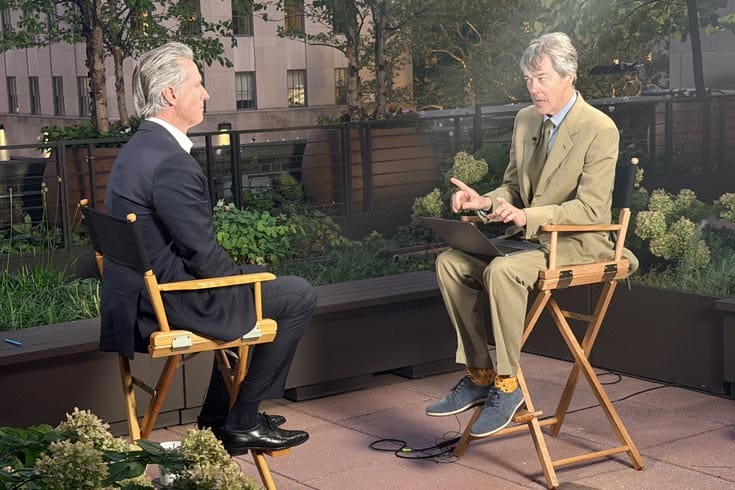
It’s a mistake for Democratic politicians not to talk about climate change, and the reason they don’t is “because they don’t know how to talk about it,” California governor Gavin Newsom said Wednesday in an interview with The Guardian and Covering Climate Now.
Speaking on the sidelines of the UN General Assembly meeting and New York Climate Week, Newsom also predicted that the midterm elections in November would bring “the end of Donald Trump’s presidency as we know it.” To prevent Trump from stealing those elections, voters must turn out in such overwhelming numbers that he “couldn’t possibly contest” the outcome. If the US president nevertheless declares a national emergency or otherwise attempts to invalidate the results, Newsom said, then “we the people have to step up. The courts have to intervene. Congress has to do its job and stand up for the rule of law.”
Although Newsom said in an interview with CNN last week that he would not run for president if Kamala Harris did, on Wednesday he did not rule out running if Representative Alexandria Ocasio-Cortez decides to run.
Commenting on CCNow and The Guardian reporting that 80 to 89% of the world’s people and 74% of Americans want their governments to take stronger climate action, Newsom condemned the “climate hushing” most Democrats have practiced since Trump returned to the White House in 2025. “I talk about [climate change] all the time,” he said. He agreed that Democrats must be “laser-focused” on voters’ affordability concerns, but the key is to “connect the dots” between those concerns and the economic impacts of extreme heat, droughts, floods, and other consequences of overheating the planet.
“People say, ‘Why are you talking about climate change? You should be talking about kitchen table [issues],’ Newsom said. “I say, ‘I am. You haven’t connected the droughts to the cost of beef, to the cost of coffee? You have to connect climate risk with financial risk, with our trade policy. These are kitchen table issues.”
“My biggest frustration during the Biden years,” he added, was that the Biden administration passed strong climate policies, including the Inflation Reduction Act, but then didn’t communicate that to the public. “Democrats fall prey to the Enlightenment Fallacy, that somehow good ideas sell themselves,” Newsom said. “We have to deliver not just good policy, we’ve also got to connect that policy to people’s lived experience and sell the hell out of it… Don’t just talk about extreme heat, talk about that farmworker in the warehouse [experiencing] that heat.”
Citing scientists’ finding that the hotter climate has supercharged the natural El Niño phenomenon into a “super El Niño,” Newsom last week declared a state of emergency in California “so we can pre-position assets” to protect the state’s inhabitants, infrastructure, and economy from the impacts. “That costs money,” he said. “Anyone who suggests that doing nothing [about the climate crisis ] is the cheaper bet? Nonsense… The cost of inaction is incalculable. It’s not just the cost of emergency preparedness, but also the economic impacts of not being able to get insurance and not being able to build housing because you can’t insure the construction.”
“Here’s the thing that keeps me optimistic: The markets are moving in our direction,” he said. “Wind, solar and large-scale batteries [are] abundant and cheap,” while the war in Iran has pushed the price of gasoline, diesel, and fertilizer to record highs…. And that’s not only happening in the United States, but globally people are realizing [that clean energy] is the better option.”
Thanks to large-scale batteries, which Newsom called “a game changer,” California ran on 100% clean electricity nine out of every 10 days so far in 2026, he said. “For the fourth largest economy in the world, that’s incredible,” he exclaimed, and it shows that planet-warming emissions can be cut without harming economic growth.
Newsom “totally rejected” criticisms by Bill McKibben and other climate activists that his administration has slowed expansion of rooftop solar in California by lowering net metering payments to homeowners with rooftop solar. Those payments, Newsom argued, “were subsidizing Wall Street hedge funds” and boosting electricity costs for Californians who “can least afford it.” The solar industry, he added, is now “a mature industry that needs to start to stand on its own,” without subsidies.
Meanwhile, Republicans are vulnerable on the climate issue because “they‘ve sold their souls to the fossil fuel industry … which lied” about the immense damage their products would do, Newsom said. “That’s why California is suing them, and other jurisdictions are suing them, on behalf of our kids and grandkids, and [industry executives’] kids and grandkids, who I love, even if they don’t.”
“The [2028] nominee of the Democratic Party is going to be the next president of the United States,” Newsom said, and Ocasio-Cortez “absolutely could be the nominee.” He rejected the assertion that a woman, or someone who is Jewish, or young, or from California can’t be elected president. “It’s insulting… Our politics is completely scrambled post-Trump, the old rules do not apply.” Ocasio-Cortez is a “generational talent,” as well as “an outstanding communicator” and “outstanding motivator,” he said. “She’s the real damn deal.”
He wouldn’t run against Harris, he explained, not only because he has “a relationship with her that goes back to before we both were in politics,” but because his and her voting bases “overlay in ways that I don’t think people have absorbed or fully appreciate.” But that is not the case with Ocasio-Cortez, he said, who he fully expects will run for president. She would be one of dozens of Democrats seeking the nomination, he predicted, “and each one of them would be better [as president] than the one we have now, and I would enthusiastically support them.”
Newsom is not ready to say whether he himself will run in 2028. He will only do so, he said, if he decides that “I have something unique that [other candidates] don’t, a voice, experience, perspective, capacity that is distinctive and adds value.” He would need to “be able to look you in the eye and say, ‘I’ll tell you exactly why I’m running for president of the United States,’ and do it authentically, not just give you a talking point. I think that’s what’s needed in our politics today: authenticity, purpose, passion, meaning, and mission. And if you don’t have all those things, then you don’t belong on the stage.”
From Us
RSVP: Betting the House: Building a Successful Reporting Collaborative. Join journalists from the new pop-up collaborative “Betting the House” TODAY, September 24, at 1pm US Eastern Time, for a conversation about how they organized, what worked, and how you can pull together pop-up collaborations to broaden your audience and your impact. Tracy Wholf, of WereWHOLF Media, will moderate.
RSVP: Demystifying This Historic El Niño & What It Means for Global Communities. On Tuesday, September 29, at 1pm US Eastern Time, join CCNow and Climate Central for a special conversation about what science tells us about this historic El Niño and how to frame its possible impacts without losing sight of the role climate change plays in influencing extreme weather and temperatures.
En las elecciones del 4 de octubre en Brasil, es probable que gane el petróleo. En la nueva edición de nuestro boletín en español para periodistas de todas las áreas, te traemos las claves para analizar las elecciones desde el punto de vista climático y del futuro de la Amazonía. Como siempre, con los recursos y expertos que necesitas para mejorar tu cobertura. Échale un vistazo a las ediciones anteriores y suscríbete para recibir el boletín los miércoles.
Watch: Suncor v. Boulder: The Climate Showdown at the Supreme Court. CCNow and Point Source News hosted a special conversation digging into questions before the high court and related story ideas reporters can explore — including the role of oil industry money, the broader attacks on climate accountability, the potential implications for climate litigation nationally, and climate impacts in Colorado.
ICYMI: The 2026 CCNow Journalism Awards WINNERS. Last week, we announced 49 winners of our sixth-annual awards. Winners hail from all over the world and outlets big and small. Covering a wide range of subjects — solutions, justice, fossil fuels, extreme weather, and many more — their work represents a model for journalists everywhere, at a critical moment for our profession. Discover the winning work.
Noteworthy Stories
Hope in solar power. A group of leading advocates, including Senator Bernie Sanders, activist and actor Jane Fonda, and climate diplomat Yeb Saño, delivered a letter to the UN this week, offering “a clear goal for the entire world to rally around: clean energy access for everyone, everywhere by 2030.” By Bill McKibben for The Guardian…
China’s 5-year plans. Nearly three-quarters of the 72 five-year plans adopted this year by China focus on climate change and energy. Dig in to this searchable database to learn more. By Anika Patel and Lekai Liu for Carbon Brief…
Electrify everything. Germany will phase out fossil fuels by 2045, the country’s environment minister Carsten Schneider told the UN General Assembly this week. Germany is the third country in the EU to provide a “solid plan” for its energy transition. By Rana Taha with AFP, dpa, Reuters for DW…
UN chief interview. Outgoing UN secretary-general António Guterres talks about the urgency of the climate emergency, why he made it a top priority, and why he’s hopeful that the speed of renewable energy adoption and production will increase in response to the ongoing crisis in the Gulf. By Fiona Harvey for The Guardian…
National security threats. UK foreign secretary Ed Miliband met with ministers from Kenya and other countries in a closed door meeting at the UN to share the findings of a damning national security report warning of the dangers of climate change that was suppressed under former prime minister Keir Starmer. By Fiona Harvey for The Guardian…
On the Beat
“How Should We Cover the Climate Story?” That’s the question answered by a roundtable of esteemed climate editors and journalists, including Emily Atkin (Heated), Katharine Bagley (Grist), Adam Mahoney (Capital B), Naomi Starkman (Civil Eats), and many more. By Carolina Abbott Galvão, Ivan L. Nagy, and Riddhi Setty for Columbia Journalism Review…
Quote of the Week
“The day is coming when our momentum will overtake the resistance. We’re getting very close now. I think we are going to win this. The remaining question is whether we will win it in time to avoid those negative tipping points I talked about.”
– Al Gore in an interview with Al Roker during Climate Week
Resources
- “Climate Diplomacy Brief special: UNGA81” (Ed King)
- “The Billion Dollar Deal: How the Fossil Fuel Industry Bought the Trump Administration, Cashed In, and Left Americans to Pay the Price” (US Senate Committee on Environment and Public Works)
- “Analysis: ‘Super El Niño’ breaks ‘remarkable’ all-time record” (Carbon Brief)
- “Warmer Fall, Later Freeze, Longer Allergy Season” (Climate Central)
- “Far-right political support and clean technology adoption in Germany” (Nature Sustainability)
- “Midterm Battleground State Poll: Political Priorities & Opinions on the Clean Energy Transition” (Environmental Voter Project)
- “The 2026 Europe Cities Report of the Lancet Countdown on health and climate change: cities at the forefront of climate change action” (The Lancet)
- “2026 Private Equity Climate Risks Scorecard & Report” (Private Equity Climate Risks)
Jobs, Etc.
Jobs. Inside Climate News is hiring a Senior Editor (remote, American West preferred). Science News Media Group is hiring a Social Media Manager (Washington, DC). Floodlight is hiring an Operations and Development Coordinator (remote). Sentient is hiring a Food and Farming Storytelling Fund Program Manager (remote, two-year term). The New York Times is hiring a Correspondent, The Economics of a Warming World and Audience Editor, Climate and Science (New York, NY). Semafor is hiring an Asia Editor (remote, ideally Singapore).
Fellowships, Tours, Grants & Pitch Opportunities.
- The Open Notebook is accepting applications for its paid, part-time early-career fellowship program; apply by October 31.
- The Vital Impacts Environmental Photography fellowship and mentorship program is accepting submissions for long-term visual storytelling projects related to communities working on environmental solutions; apply by November 30.
- Green Central Banking is accepting pitches from journalists in the EU, UK, or Southeast Asia about monetary and public policy issues related to climate change and the energy transition.
- Earth Island Journal is accepting pitches.
- The Pulitzer Center is offering Work/Environment Reporting Grants with a particular interest in reporting from regions in Southeast Asia, Europe, Africa, and South America.