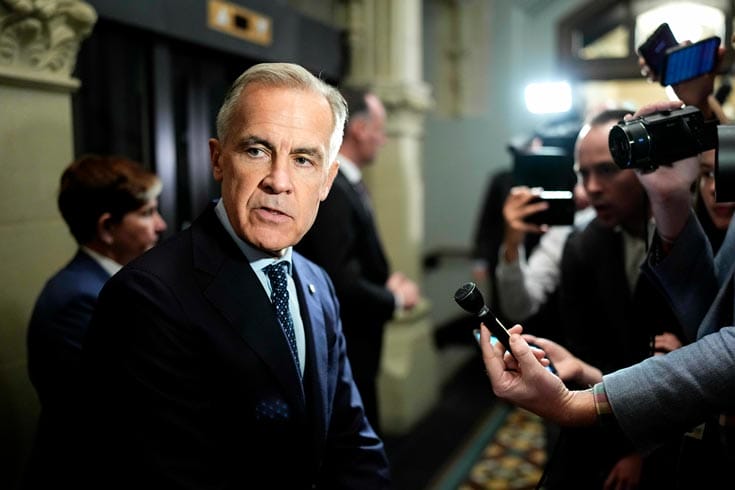
Before being elected Canada’s prime minister in April 2025, Mark Carney championed ambitious climate action grounded in rigorous science. As the head of the Bank of England, he warned that limiting temperature rise to 2 degrees Celsius would require leaving trillions of dollars’ worth of oil, gas, and coal in the ground. Fearing a repeat of the 2008 global financial collapse, he then ordered UK banks to undergo climate stress tests to demonstrate they could remain solvent if most fossil fuels were indeed left undeveloped.
Now, though, facing threats from US president Donald Trump, Carney has said that Canada should become “a global energy superpower.” How? By boosting exports of the very fossil fuels he once warned against, including the super-dirty oil sands that gave rise to the landmark Keystone XL protests 15 years ago.
The Climate Beat occasionally republishes significant journalism by Covering Climate Now partners. (Email CCNow’s Executive Editor, Anna Hiatt, at anna@coveringclimatenow.org with pitches.) This week, Chris Hatch highlights Carney’s about-face in “Zero Carbon,” his newsletter for Canada’s National Observer; subscribe here.
It was quite a week on the fossil front in Canada. On September 29 prime minister Mark Carney arrived in Vancouver to celebrate the multinational consortium moving ahead to build LNG Canada Phase 2. It will become the second-largest liquid natural gas facility in the world, the PM cheered.
Carney, along with British Columbia premier David Eby, also “welcomed” the decision by TC Energy to double the capacity of the Coastal Gas Link pipeline, which will boost the transport of fossil gas to the Pacific coast from the fracking grounds in Alberta and northeastern BC.
Two days later, Carney and Danielle Smith, the premier of Alberta province, appeared on a podium in Fort McMurray. Dwarfed by a gargantuan, self-driving oilsands truck, they announced that a new bitumen pipeline had been designated as being in the “national interest.” It will be called the Pacific Link and will be fast-tracked to the West Coast.
Amongst the frenzy of fossil fuel announcements, Carney paused to announce funds for Canada’s beleaguered Pacific coast: A boost to the “ocean protection” budget; an offering to allay pesky concerns over the vanishing Southern Resident orcas whose plight might stymie the nation’s quest to become a seafaring superpower in oil and gas.
It would be wrong to say that concerns about the climate didn’t figure at all in these announcements. On both days, flicking between TV stations, you would have seen chyrons crawling across the screen noting that Swiss glaciers had lost one-fifth of their ice in the past five years. Or that California had declared a state of emergency as homes washed away and a “Kelvin wave,” boosted by global heating, was closing in. Another caption mentioned fires in Indonesia choking cities in Asia.
Meanwhile, the climate content of Canadian officials’ announcements veered between tortured logic and outright celebration over knocking back climate action. Carney said the world faces a three-front energy crisis, one third of which is “the existential challenge of climate change.” Then, with barely a segue, he outlined a world where oil demand will create lucrative economic opportunities for decades to come. “The question is: who will emerge as the world’s trusted suppliers? It should be us. … The oil sands are part of Canada’s once-in-a-generation opportunity to become a global energy superpower.”
Premier Smith then recounted the climate policies Alberta had beaten back to arrive at the Pacific Link announcement. Alberta forced the feds to get rid of the electric vehicle mandate, Smith said. A cap on emissions from the oil and gas sector was removed, and there will be an “abeyance” of clean electricity regulations. A graceful winner, Smith did not bring up the PM’s requirement from less than a year ago that any new pipeline would have to be built by the private sector.
It would be one thing if the arguments for expanding fossil fuels were geostrategic or economic. The public could weigh the projects and forecasts against protection of lives, species and livelihoods. Instead, the political pronouncements have been corrosive, equating fossil fuels with climate protection and pipelines with nature.
Do you care about killer whales? We have just the pipeline for you, runs the argument. Or, in Carney’s more subtle telling, ocean protection and the pipeline are all “part of one plan.”
Worried about a future filled with ever more megatonnes and gigatonnes of carbon pollution? Relax, our fossil fuels are a form of climate action, runs the tortured logic. Canada’s gas is “low emissions” and our oil is “low carbon,” repeated the premier, prime minister and every cabinet member in range of a microphone. Never mind that all these claims amount to rounding errors in the full life cycle of climate pollution.
No one at the podiums was saying outright that the more fossil fuels we burn, the more we save. But they’re inching right up to it. Fossil fuels are climate action. Pipelines are nature protection. If the public absorbs those comforting conflations, maybe that’s all part of the plan.
From Us
RSVP: Climate Change’s Toxic Hazards. CCNow will explore the intersection of toxic pollution, Superfund sites, and climate change on Tuesday, October 13, at 12pm US Eastern Time. Hear from journalists who have reported on these rising toxic risks in some of the most vulnerable states — Florida, Louisiana, New Jersey, and California.
Radar Clima: Nuestra generación está viendo cómo desaparecen los glaciares. Son vitales para el suministro de agua de millones de personas en América Latina, y estamos presenciando su retroceso y extinción. ¿Qué significa esto para las comunidades que dependen de ellos? ¿Hay soluciones que estén funcionando? Échale un vistazo a las ediciones anteriores de Radar Clima y suscríbete para recibir el boletín los miércoles.
Watch: Climate on the Ballot: Voters Want Candidates to Talk About It. CCNow’s Kyle Pope talked with Nathaniel Stinnett of the Environmental Voter Project, Matto Mildenberger of The 2035 Initiative at UC Santa Barbara, and Kate Yoder of Grist yesterday about recent polling that shows climate is on voters’ minds, what races to watch, and what elected officials are and aren’t saying about climate action.
Noteworthy Stories
Far-right gains. The results of the Brazil elections are concerning Indigenous and environmental organizations, who say that Bolsonaro’s party, which won the most seats in Congress, threatens Indigenous peoples. By Jonathan Watts for The Guardian…
Climate at SCOTUS. On Monday, the US Supreme Court heard arguments in Suncor v. Boulder, one of dozens of climate accountability lawsuits brought by states, local municipalities, tribes, and people against oil companies for the harm climate change has wrought. The justices “weren’t buying some of Big Oil’s arguments.” By Emily Sanders and Rebecca Leber for Point Source News…
- In a New York Times op-ed, journalist and author Jeff Goodell writes about the evolution of attribution science and why it has oil companies “running scared.”
Mothers at risk. At pre-COP meetings taking place this week in Fiji, attendees campaigned to put the maternal risks of climate change on the agenda at the upcoming talks in Antalya, Turkey, next month. Pregnancy is becoming “a time of anxiety, as climate impacts fill everyday life with risk,” said Simon Stiell, the head of the UNFCCC. By Megan Rowling for Climate Home News…
‘Habitability crisis.’ In France, one question dominated media coverage and public conversations over the course of the summer heatwaves: “Should we move to escape the furnace?” This carousel explores the question of how climate change is forcing us to reconsider our relationship to our lived environments. By @lemonde_en on Instagram…
Quote of the Week
“We’ve stopped naming what is happening to us.”
– Dr. Leah Stokes, lamenting the “silence from so many politicians and media outlets” as climate change drives humanity “toward an off-the-charts ‘Super El Niño.’”
On the Beat
How’d they do that? Journalists from Europe, South America, the Philippines, and the US who published blockbuster climate investigations that combined innovative data analysis with on-the-ground reporting to uncover critical environmental issues share their process. By Diego Arguedas Ortiz for the Global Investigative Journalism Network…
UK’s Reform Party is launching a “newsroom,” hiring people to staff “a modern operation designed around how audiences consume content today, and how they’ll consume it tomorrow,” Aaron Lobo, who was previously Farage’s executive producer at GB News and then Reform’s director of operations, wrote on LinkedIn. By Charlotte Tobitt for Press Gazette…
Media ‘behemoth.’ The Paramount–Warner Bros. Discovery merger was completed this week after a nearly year-long battle. The new company Skydance will oversee US television networks CBS, CBS News, CBS Sports, CNN, TNT, TBS, Nickelodeon, and MTV, among others.
Resources & Events
- Event: GIJN’s online conference IJ WEEK (October 26–30) will present more than 100 speakers from around the world dedicated to investigative journalism. Learn more + register.
- “New Study Shows Personal Climate Actions and Collective Change Reinforce Each Other, Not Compete” (Happy Eco News)
- “Techno-optimistic scientists take fewer climate actions” (London School of Economics)
- “A study of nonprofit newsrooms reveals some cracks in the model’s foundation” (Nieman Lab)
- “Three Things to Know: El Niño and Global Temperatures” (Climate Central)
- “Global sea-level rise will create a new biological invasion front” (Nature Ecology & Evolution)
Jobs, Etc.
Jobs. Columbia University’s Graduate School of Journalism is hiring a David Laventhol Visiting Professor (New York, NY). The Bureau of Investigative Journalism is hiring a Climate and Environment Editor (London). CBS Miami is hiring a Meteorologist (Miami). Telemundo is hiring a Meteorologist (Dallas, Texas). KWES-TV is hiring a Chief Meteorologist (Midland-Odessa, Texas). WBZ-TV is hiring a Meteorologist (Boston, Mass.). Inside Climate News is hiring a Senior Editor (remote, American West preferred). Science News Media Group is hiring a Social Media Manager (Washington, DC). Floodlight is hiring an Operations and Development Coordinator (remote). Sentient is hiring a Food and Farming Storytelling Fund Program Manager (remote, two-year term). The New York Times is hiring a Correspondent, The Economics of a Warming World and Audience Editor, Climate and Science (New York, NY). Semafor is hiring an Asia Editor (remote, ideally Singapore).
Fellowships, Tours, Grants & Pitch Opportunities.
- The Pulitzer Center is accepting applications for its second Climate Storytelling Accelerator; apply by October 9.
- The Guardian is accepting applications for its Digital Scheme apprenticeship program that supports early-career journalists; apply by October 12.
- Informed Earth is hosting a four-day in-person media workshop from November 5–8 for journalists and digital content creators reporting in Kyrgyzstan on biodiversity, conservation, and environmental policy; apply by October 14.
- High Country News and Report For America are seeking four newsrooms to join their Western Environmental Reporting Collaborative and host reporters focused on the land, water, climate, and people of the West; apply by October 19.
- The Solutions Journalism Network/MIT Climate Journalism Fellowship is an eight-month program supporting 10 US-based freelance and staff journalists to report on climate solutions in local and regional outlets; apply by October 26. Register for an informational session on October 14, at 3:30 pm US Eastern Time.
- The Open Notebook is accepting applications for its paid, part-time early-career fellowship program; apply by October 31.
- The Vital Impacts Environmental Photography fellowship and mentorship program is accepting submissions for long-term visual storytelling projects related to communities working on environmental solutions; apply by November 30.
CCNow Journalism Awards
Over the coming months, in each edition of this newsletter, we’ll be spotlighting one category from the 2026 Covering Climate Now Journalism Awards. See all the winning work and help us celebrate the winners here.

This week, we’re highlighting winners from the Justice category. Climate change often hits first and hardest marginalized countries and communities that have contributed the least to the problem. While justice is mentioned in many climate stories, in this category, judges considered work featuring a justice angle as its primary subject — among them: peril and hope on the frontlines of the climate crisis, unexpected intersections of climate change with other systems of injustice, and marginalized groups pioneering solutions to show the world a path forward.
Inside the Indonesian Boomtowns Powering the World’s Electric Vehicles
By Wufei Yu
Grist
The Eaton Fire’s Impact on Black Families
By Adam Mahoney
Capital B
Beneath the Panel: The Hidden Losses of India’s Solar Parks
By Aparna Ganesan with Jai, Jeeva, Dinesh Raja, Siva, Sachin Bharathvaj, R Mugesh & Roli Srivastava
The Migration Story (India)
Check out the citations for these winners and find links to their stories here.