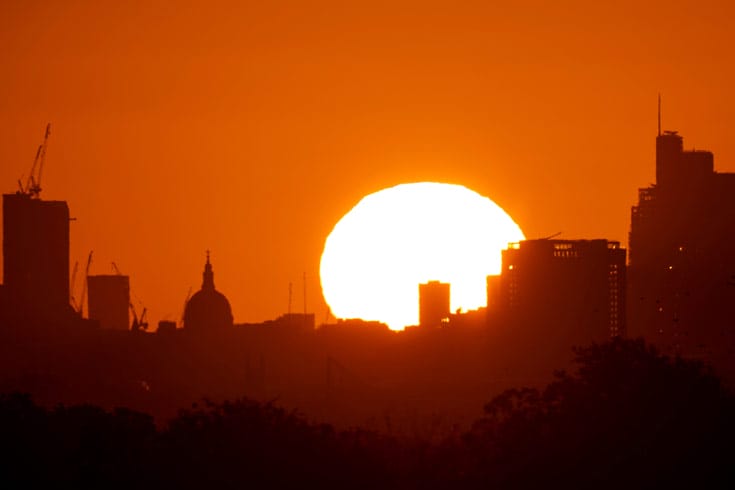
In a landmark piece of climate journalism, Reuters has just published a groundbreaking investigation arguing that the term “heat waves” no longer adequately captures what is happening on the planet. A better term is “heat storms,” wrote Maurice Tamman, a veteran investigative journalist who was the lead reporter on “The Age of Heat Storms” project.
“[S]upersized heatwaves used to be rare,” Tamman wrote. “No longer. Now they swarm the planet.” In a video accompanying the report, he explained that, “whereas heatwaves were once small and relatively self-contained, now we live in a world where these heatwaves are massive.”
Drawing on interviews with dozens of scientists and researchers, Reuters defined a “heat storm” as an episode of “abnormally high temperatures” that lasts for at least five consecutive days and covers more than 1% of Earth’s surface, an area roughly the size of half of Canada. Whereas the planet averaged about five heat storms in the 1960s, the largest of which covered 6% of the planet and lasted for 46 days, the average today is 102 heat storms per year, the largest of which affected 85% of Earth’s surface “and virtually every single human being living in 2023 and 2024.”
Heat storms, Tamman added in the video, are not only larger and stronger than heatwaves, they “are also different in another way: They are cascading, where there is an endless series of storms, one after the other.” Indeed, for the last 18 years straight, “at least one heat storm has been roiling the planet, and often more than one,” according to a fresh analysis of global temperature data that Reuters conducted with the scientists.
Tamman, who won a Pulitzer Prize in 2025 for an exposé of the global fentanyl trade and has covered climate change for years, was drawn to this project after having long been “frustrated by a disconnect between scientists and the public,” he wrote. It can be useful for scientists and policymakers to talk about the need to limit global warming to 2 degrees Celsius above pre-industrial levels, he acknowledged, but “what is an ordinary person to make of that? Not much.” Extreme heat, on the other hand, is something that ordinary people viscerally understand — and that nearly everyone on Earth has now experienced. In recent months, global warming and the heat that follows has become even more visceral, bringing ever more extreme events like last summer’s Nepal glacier collapse and the deaths of more than 35,000 people across Europe.
Like the best climate reporting, the Reuters investigation both humanized and localized the story. One installment told the story of Justice Trumpler, a 17-year-old high school football captain in Texas who invites college recruiters to watch him play, only to succumb to non-stop vomiting in the 100 degrees Fahrenheit heat and end up in the hospital. Another installment described how hundreds of the iconic pink dolphins that inhabit the Amazon river were literally cooked to death by extreme heat. In the Philippines, a math teacher saw a student face-down on his desk, crying; when the teacher coaxed him to sit up, the boy’s face and chest were covered in blood from a spontaneous nosebleed, a common malady in extreme heat.
All this and more is happening, bear in mind, after average global temperatures have risen by “only” 1.4 degrees C. And because emissions continue to increase, temperatures are projected to rise to at least 1.7 C by roughly 2050, the UN Environment Programme said in its annual “Emissions Gap” report, released yesterday. A key reason emissions keep increasing, The New York Times reported, is that the US under President Donald Trump has reversed the country’s previous efforts to limit fossil fuel production. To limit the amount of “overshoot” of the Paris Agreement goal of 1.5 degrees C of temperature rise, UNEP said, “a massive global scale-up” in emissions reductions will be needed, a goal certain to be discussed at the COP31 UN climate summit taking place in Turkey from November 9 to 20.
To help both the public and policymakers grasp how harshly even today’s 1.4 degrees C of global warming is transforming life on Earth, the Reuters project suggested that heat storms be given names, just as hurricanes routinely are. “Naming events,” the report said, “is ‘a powerful way for people to understand that something is happening,’ Anthony Leiserowitz, director of the Yale Program on Climate Change Communication, told Reuters. Yet ‘we don’t currently do that with heatwaves,’ he said, even though heat has been estimated to kill almost half a million people a year.”
In online discussions, some meteorologists have bristled at the term “heat storm.” David Dickson, Covering Climate Now’s resident meteorologist, noted that “storm” is a term “with a very distinct meteorological definition that is the opposite of what happens during extreme heat (storms occur with low pressure, heat with high pressure).” However, Dickson added, “I can’t think of a better name, and think it does the job in communicating impacts quite well — and we already have other things described as storms that aren’t, i.e. solar storms.”
For nearly a decade, thousands of climate scientists have been deliberately using the term “emergency” to describe how fast and dangerously global warming is intensifying. Activists picked up the “emergency” framing as well, but the Reuters findings underscore that that framing has always been fundamentally a matter of science, not politics.
From Us
RSVP: Why COP31 Could Surprise Us. Join us TODAY, Thursday, October 22, at 12pm US Eastern Time, for a press briefing with superstar panelists Kumi Naidoo, President of the Fossil Fuel Treaty initiative; Johan Rockström, Director of the Potsdam Institute for Climate Impacts Research; Ana Toni, COP30’s CEO and Executive Director; and Stientje van Veldhoven, The Netherlands’ Minister of Climate and Green Growth.
RSVP: Prep Yourself to Cover COP31 — From Turkey and Remotely. Next week, join a CCNow-hosted session designed to get you ready to cover the upcoming UN climate summit. We’re hosting the session at four different times to fit your schedule:
- October 27, at 7am UTC
- October 27, at 4pm UTC
- October 28, at 1pm UTC
- October 29, at 3pm UTC (6pm Amman time)
APPLY: The Climate Newsroom. Join the fall cohort of CCNow’s free, three-session training program for US-based journalists. Apply by Friday, October 30; classes start Tuesday, November 3.
2026 Elections Guide. Access the latest polls and studies connecting climate to local and national races, recordings of conversations with experts on energy affordability and voter concerns, and a collection of stories we like about how climate factors into local, state, and congressional races.
- Plus, sign up for CCNow’s pop-up elections newsletter, Climate on the Ballot, for inspiration to help you integrate climate change into your midterms coverage. The second edition looks at climate-first voter turnout.
Noteworthy Stories
Overshoot scenarios. For the first time, the annual UN Emissions Gap report, released Wednesday, states that overshooting 1.5 degrees Celsius of temperature increase is “imminent and unavoidable” and that the goal now is to limit the overshoot by phasing out fossil fuels. By Andrew Freedman for CNN…
Crucial election. Deforestation has dropped to its lowest level ever recorded in the Amazon this year, according to Brazil’s government. But that progress could be reversed if Flavio Bolsonaro, a climate denier, wins next week’s election. Critics worry his vague pledge to end illegal deforestation means he will make it legal. By Sergio Peçanha and Ana Ionova for The New York Times…
- Meanwhile, ClimaInfo reports that IBAMA, the federal environmental agency, has issued R$2 million in arson fines for numerous wildfires surrounding the metropolitan capital of Manaus. Officials say they were set to attack the Lula government in a “political war.”
School daze. Student protestors in France say that climate change made their classrooms unbearably hot during the summer’s extreme heatwaves creating unhealthy conditions that brought on heat exhaustion, headaches, and nosebleeds. By Mathilde Augustin for Inside Climate News…
US elections. Voters in red and blue states want politicians to talk more about climate change, but candidates are quiet on the issue. Why? By Oliver Milman for The Guardian…
Lack of action. The UN Conference on Biological Diversity (COP17) kicked off this week in Armenia “with daunting challenges.” Despite the fact that 196 countries signed on to the Kunming-Montreal Global Biodiversity Framework four years ago, very little progress has been made on the agreement’s 23 targets. By María Mónica Monsalve S. for El País…
Quote of the Week
“Climate science must continue to advance even if it’s not politically favored. Communities are still at risk of climate impacts, whether or not the government aligns with what those risks are.”
– Professor Costa Samaras, lead author of a new climate paper published Tuesday that originally had been cancelled by the Trump administration, told The Washington Post
On the Beat
- “Under Bari Weiss, CBS News dismantled its climate team and retreated from climate reporting” (Media Matters for America)
- Forty percent of Americans regularly get their news from Facebook, according to new Pew Research Center polling; another 34% say they rely on YouTube.
Resources & Events
- “Higher Temperatures Fuel Gun Violence. Now We Know How Much Is From Climate Change” (Climate Central and The Trace)
- “Plumes in the Permian: How New Mexico can leverage satellites to find and fix oil and gas emissions” (Earthworks and the Gas Leaks Project)
- “185 Groups Slam Permitting Reform’s Sweetheart Deal for Data Centers” (Food & Water Watch)
- “The 2023 North Atlantic marine heatwave could have evolved into a far more extreme event” (Nature Communications)
- “Heat-related urban mortality attributable to human-induced climate change in Europe from 2000 to 2025” (Nature Health)
- “Citizens’ assemblies propose ambitious climate policy but impacts remain limited” (Nature Climate Change)
- “Political affiliation impacts climate attention and choice beyond extreme weather exposure” (Nature Climate Change)
- RSVP: We’re Still Here: Persistence, Resistance, and Environmental Journalism, hosted by The Uproot Project in person, in San Francisco, on Thursday, October 22, at 6pm US Pacific Time
- RSVP: Recovery, Resettlement, and Risk in the Aftermath of Nepal’s Bhotekoshi-Trishuli Disaster, hosted by The Stimson Center on Monday, October 26, at 9:45am US Eastern Time
- Webinar: Marine Minerals and the Media: A Webinar for Journalists on Deep Sea Mining, hosted by Earth Journalism Network on Thursday, October 29, at 11am US Eastern Time
Jobs, Etc.
Jobs. Elsevier is hiring a Senior Scientific Editor, Environmental Science
(Chennai, India). S&P Global is hiring a Reporter, Electrification and Climate Markets (Houston or Washington). The Houston Chronicle is hiring an Energy and Data Center Reporter (Houston, Tex.). New Hampshire Public Radio is hiring a Climate Change Reporter (Concord, N.H.). The Audubon Society is hiring a Senior Writer, Executive Communications (Washington, D.C.) Bloomberg Industry Group is hiring a News Team Lead – Environment (Arlington, Va.). Heatmap is hiring a Senior Editor (remote). Gulf Coast News is hiring a Meteorologist (Fort Myers, Fla.). Columbia University’s Graduate School of Journalism is hiring a David Laventhol Visiting Professor (New York, NY). The Council on Foreign Relations is hiring a Research Associate, Energy and Climate (New York, NY). Floodlight is hiring an Operations and Development Coordinator (remote).
Fellowships, Tours, Grants & Pitch Opportunities.
- The Solutions Journalism Network/MIT Climate Journalism Fellowship is accepting applications for an eight-month program supporting 10 US-based freelance and staff journalists to report on climate solutions in local and regional outlets; apply by October 26.
- Internews’ Earth Journalism Network (EJN) is accepting applications for an in-person fellowship program that will support selected fellows to attend and report from the Biodiversity Beyond National Jurisdiction COP1 scheduled for January 11–22, 2027, in New York City; apply by October 27.
- Informed Earth is accepting applications from reporters and editors for its new climate journalism training program; apply by November 1.
- The National Institute for Computer-Assisted Reporting is accepting applications for the Philip Meyer Journalism Award, which rewards outstanding work using social science research methods; apply by November 18.
- The New York Times is accepting applications for the Times Fellowship, its yearlong opportunity for early career journalists; apply by November 20.
- Investigative Reporters & Editors is accepting applications for its Data Journalism Bootcamp scheduled for January 11–15, 2027 in Columbia, Mo.; apply by December 6.
CCNow Journalism Awards
Over the coming months, in each edition of this newsletter, we’ll be spotlighting one category from the 2026 Covering Climate Now Journalism Awards. See all the winning work and help us celebrate the winners here.

This week, we’re highlighting winners from the Extreme Weather & Its Impacts category. Stories in this category made clear the connection between weather disasters and human-caused climate change. Strong explanations of how climate factors into extreme weather — hurricanes, floods, wildfires, extreme heat and cold, and more — as well as human-centered stories of disasters and their aftermath told with a climate lens, can help inform the public about the bigger picture.
Floods of Trouble
By Alex Harris & Susan Merriam
Miami Herald
The Storm
By Jonah Goodman with Maurice Haas, Sebastian Broschinski, Francisco Martinez Ruiz & Céline Stettler
Tages-Anzeiger’s Das Magazin (Switzerland)
Where Land Disappears
By Usraat Fahmidah with Rifat Anik
Asian Dispatch (India)
Check out the citations for these winners and find links to their stories here.