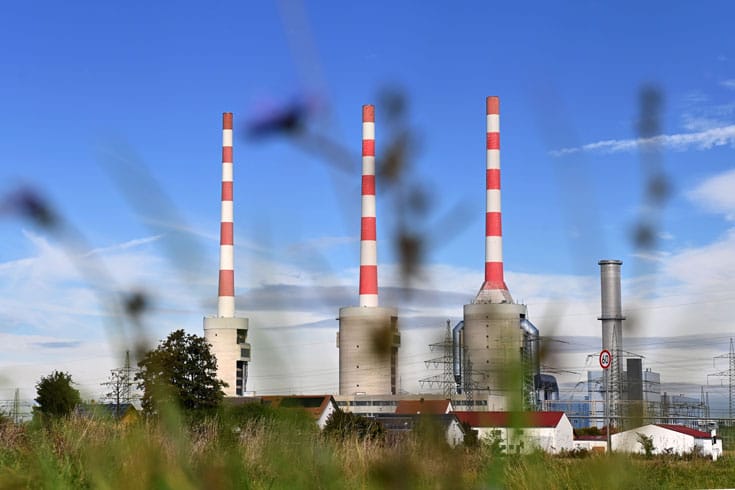
The biggest news during last week’s Climate Week NYC came not from the US but from Germany, where the government of the world’s third-largest economy committed to phasing out fossil fuels by 2045. It was the first time Germany has explicitly made such a promise, Fiona Harvey noted in The Guardian. Germany’s previous pledges, Harvey added, “were only for ‘carbon neutrality,’” an important distinction. Carbon neutrality allows continued fossil fuel use if the emissions are offset—for example, by additional clean energy or tree planting. But only a complete phaseout of fossil fuels can halt global temperature rise.
Meanwhile, Gavin Newsom, the governor of California, the world’s fourth largest economy, hailed his state’s decarbonization efforts, saying in an interview with Covering Climate Now that California has run on 100% clean electricity nine out of every 10 days so far in 2026. And as the costs of solar, wind, and batteries continue to fall, while the Iran war makes gasoline and diesel more expensive, “the markets are moving in our direction,” said Newsom, who’s widely expected to run for president in 2028. “Globally, people are realizing [that clean energy] is the better option.”
An overwhelming majority of people around the world want their governments to take stronger climate action, the Associated Press noted in an article about the global oat milk company Oatly endorsing CCNow’s 89 Percent Project. “Companies should be taking much more responsibility, not only in reducing their own environmental footprint, but really working out how they can use their platform to drive a positive future,” Caroline Reid, senior sustainability director at Oatly, told the AP.
Mirroring this public sentiment, Germany and California are key members of a “coalition of the willing” that emerged from last year’s COP30 UN climate summit after petrostates vetoed calls from 80-plus countries to develop a global “roadmap” to phase out fossil fuels. Collectively, this coalition amounts to the biggest economic superpower on Earth. In April, many of its members met in Santa Marta, Colombia, to begin discussing, in UN Secretary-General António Guterres’s words, how “to sequence the decline of fossil fuel investment with the rapid scale-up of clean energy.”
Journalists have a critical role to play as governments work to phase out fossil fuels. That goal can only be achieved quickly — and speed is of the essence, scientists emphasize — if countries implement genuine climate solutions and shun false ones. News coverage that makes clear how well a given policy measures up to what’s needed, as Harvey did with her distinction between “carbon neutrality” and a fossil fuel phase-out, can keep the public informed and hold policymakers to account.
France and The Netherlands are two more big economies that have released roadmaps to phase out fossil fuel use. If enough other countries present credible plans for doing so, it “would send an unmistakable message that the age of oil, gas and coal is ending, and the smart money is shifting,” Mohamed Adow, director of the nonprofit Power Shift Africa, said in an interview with The Guardian.
As the costs of clean energy fall, humanity is in a “final battle” against the “evil forces” trying to keep the world dependent on fossil fuels, said Johan Rockstrom, the director of the Potsdam Institute for Climate Impacts Research in Germany, at a Climate Week event. Scientists at Rockstrom’s institute have studied which policies significantly reduce emissions, and which don’t. A paper published in Science evaluated “1,500 climate policies implemented … across 41 countries” and concluded that only 63 of them delivered significant reductions. There is no “one-size-fits-all” solution, but getting fossil fuel prices right — by slashing subsidies and otherwise challenging what US senator Sheldon Whitehouse calls Big Oil’s “pollute for free business model” — is essential. Complementary research the Drawdown Institute released during Climate Week highlighted a number of supposed solutions that are anything but. The institute’s list of “weak ideas and greenwashing tricks” includes carbon capture and storage, direct air capture of carbon dioxide, blue hydrogen, and corn ethanol.
A frequent topic of conversation at Climate Week was the US midterm elections, which could curb President Donald Trump’s acceleration of climate breakdown if Republicans lose control in Congress, though most Democrats (with important exceptions like Newsom and Whitehouse) are saying little about climate change on the campaign trail. Considering that 80 to 89% of the world’s people, and 74% of Americans, want stronger climate action, why do so many politicians practice “climate hushing”? And why do so many voters end up backing candidates who are indifferent at best to tackling climate change?
“We need to remember,” Rockstrom said, “that citizens have many other problems besides climate change, especially the cost of living. So, we need to make it easy for them to choose clean energy options, and that requires good policy.” It also requires, Newsom said, talking plainly about both the dangers and the solutions to the climate crisis. Leaders need to “connect the dots” between the heat, drought and other afflictions driven by climate change and “kitchen table” issues like the price of beef, coffee, and home insurance. “The cost of inaction,” Newsom added, “is incalculable.”
From Us
RSVP: Climate Isn’t a Top Issue. It Could Still Swing the Midterms. Join CCNow for a special conversation with Nathaniel Stinnett of the Environmental Voter Project, Matto Mildenberger of The 2035 Initiative at UC Santa Barbara, and Kate Yoder of Grist on Wednesday, October 7, at 12pm US Eastern Time, for a conversation about recent polling that shows climate is on voters’ minds, what races to watch, and what elected officials are and aren’t saying about climate action.
Radar Clima: El agua que mueve el comercio mundial en el Canal de Panamá es la misma que beben millones de panameños. Con la llegada de El Niño, la sequía ya ha obligado a recortar el número de pasajes, una medida que puede afectar a comunidades en toda América Latina y España, así como a las comunidades locales. Échale un vistazo a las ediciones anteriores y suscríbete para recibir el boletín los miércoles.
Watch: Demystifying This Historic El Niño & What It Means for Global Communities. CCNow and Climate Central hosted a special conversation with meteorologists, reporters, and international experts about what science tells us about this historic El Niño and how to frame its possible impacts without losing sight of the role climate change plays in influencing extreme weather.
Watch: Suncor v. Boulder: The Climate Showdown at the Supreme Court. CCNow and Point Source News hosted dug into the blockbuster climate case coming before the high court next week and related story ideas reporters can explore — including broader attacks on climate accountability, the potential implications for climate litigation nationally, and climate impacts in Colorado.
Noteworthy Stories
Hot oceans. Ocean waters surrounding Europe reached the highest temperatures on record this summer. The warm water is “transforming marine ecosystems” with devastating consequences for fisheries in the region. By Ben Welsh, Simon Jessop, and Kate Abnett for Reuters…
Methane rule delay. EU officials say they are considering delaying a new rule for imported fuel, which will require foreign oil and gas companies to track and report their methane emissions. The rule is supposed to go into effect January 1, 2027. By Kate Abnett and Sudip Kar-Gupta for Reuters…
Legal discovery. US universities are receiving a surge of open records requests by right-wing actors for climate scientists’ research drafts, emails, and other communications. The requests come as the Trump administration, fossil fuel companies, and others are looking for ways to block dozens of state and local lawsuits seeking compensation for climate impacts. By Chelsea Harvey, Lesley Clark, and Corbin Hiar for POLITICO…
Just futures. Nepal’s prime minister Balen Shah delivered a powerful argument for climate justice in his speech at the UN last week, saying, “The people of our country must be allowed to build their future instead of constantly rebuilding their past.” By Faisal Mahmud for Scroll.in…
Visualizing heat. Bologna photographer Michele Lapini took pictures with his iPhone and a thermal sensor to document temperatures in homes, offices, and public spaces this summer to highlight the invisible injustice of extreme heat. By Bob Berwyn for Inside Climate News…
Quote of the Week
“I don’t think people are against the energy transition, but some of them are against the idea that other people are going to tell them how to live. It really has to be a voluntary adoption.”
– Holly Buck, a sociologist and energy policy researcher who was named a MacArthur “genius” fellow this week, in an interview with Resources Radio
Resources & Events
- Event: GIJN’s online conference IJ WEEK (October 26–30) will present more than 100 speakers from around the world dedicated to investigative journalism. Learn more + register.
- “451,000 at Risk: Where Action Can Save Lives During the Super El Niño” (Climate Impact Lab)
- “Mapping the Ecosystem of Climate Communication in the US and Canada: A Landscape Assessment” (American University)
- Spotlight on Women in Global Climate and Environmental Leadership” (GWL Voices)
- “Analysis: ‘Super El Niño’ breaks ‘remarkable’ all-time record” (Dr Zeke Hausfather, Carbon Brief)
- “Intersecting vulnerabilities: A review of climate change and the wellbeing of girls and young women in sub-saharan Africa” (Taylor & Francis)
- “20 Years of Wildfire Smoke in the US” (Climate Central)
- “Atmosphere Watch: new analysis tracks global air quality and transboundary pollution in 2026” (Copernicus Atmosphere Monitoring Service)
- “Increasing storage temperature of frozen foods: effect on sustainability and food quality” (npj Science of Food)
- “Why School Districts Say They Love Their Electric School Buses” (WRI Resources)
Jobs, Etc.
Jobs. The Bureau of Investigative Journalism is hiring a Climate and Environment Editor (London). CBS Miami is hiring a Meteorologist (Miami, Fla.) Telemundo is hiring a Meteorologist (Dallas, Texas). KWES-TV is hiring a Chief Meteorologist (Midland-Odessa, Texas). WBZ-TV is hiring a Meteorologist (Boston, Mass.) Inside Climate News is hiring a Senior Editor (remote, American West preferred). Science News Media Group is hiring a Social Media Manager (Washington, DC). Floodlight is hiring an Operations and Development Coordinator (remote). Sentient is hiring a Food and Farming Storytelling Fund Program Manager (remote, two-year term). The New York Times is hiring a Correspondent, The Economics of a Warming World and Audience Editor, Climate and Science (New York, NY). Semafor is hiring an Asia Editor (remote, ideally Singapore).
Fellowships, Tours, Grants & Pitch Opportunities.
- The Pulitzer Center is accepting applications for its second Climate Storytelling Accelerator; apply by October 9.
- The Guardian is accepting applications for its Digital Scheme apprenticeship program that supports the development of early-career journalists.
- The Solutions Journalism Network/MIT Climate Journalism Fellowship is an eight-month program supporting 10 US-based, freelance and staff journalists to report on climate solutions in local and regional outlets; apply by October 26. Attend an informational session on October 14, at 3:30 p.m. US Eastern Time. Register here.
- The Open Notebook is accepting applications for its paid, part-time early-career fellowship program; apply by October 31.
- The Vital Impacts Environmental Photography fellowship and mentorship program is accepting submissions for long-term visual storytelling projects related to communities working on environmental solutions; apply by November 30.
CCNow in the News
“Pop-up newsroom.” As more climate journalists are laid off or decide to go solo, a group of journalists are exploring ways to bring back the collaboration that a newsroom offers with a new model for independent journalists. “Betting the House,” which CCNow advised on and supported and which was published in mid-September, was their first project together. By Neel Dhanesha for NeimanLab Blog…
Got milk? Oatly, the world’s largest producer of oat milk, is encouraging its customers and their governments to take climate action, in a new milk carton campaign featuring CCNow’s 89 Percent Project. By Anton L. Delgado for the Associated Press…
CCNow Journalism Awards
Over the coming months, in each edition of this newsletter, we’ll be spotlighting one category from the 2026 Covering Climate Now Journalism Awards. See all the winning work and help us celebrate the winners here.

This week, we’re highlighting winners from the Solutions category. Science is unequivocal that solutions are urgently needed to confront the climate crisis. Great journalism doesn’t just explain potential solutions, it interrogates them: Do they achieve what they promise, do they measure up to what science demands, and are they just? This year’s Solutions category was made possible with support from the Yale Program on Climate Change Communication.
For Climate and Livelihoods, Africa Bets Big on Solar Mini-Grids
By Victoria Uwemedimo & Katarina Zimmer
Knowable Magazine
Leave It to Beavers
By Molly Bentley, Gary Niederhoff, Shannon Geary, Brian Edwards & Nsikan Akpan
Big Picture Science
Refreezing the Arctic
By Alec Luhn with Taylor Roades
Scientific American
Check out the citations for these winners and find links to their stories here.